
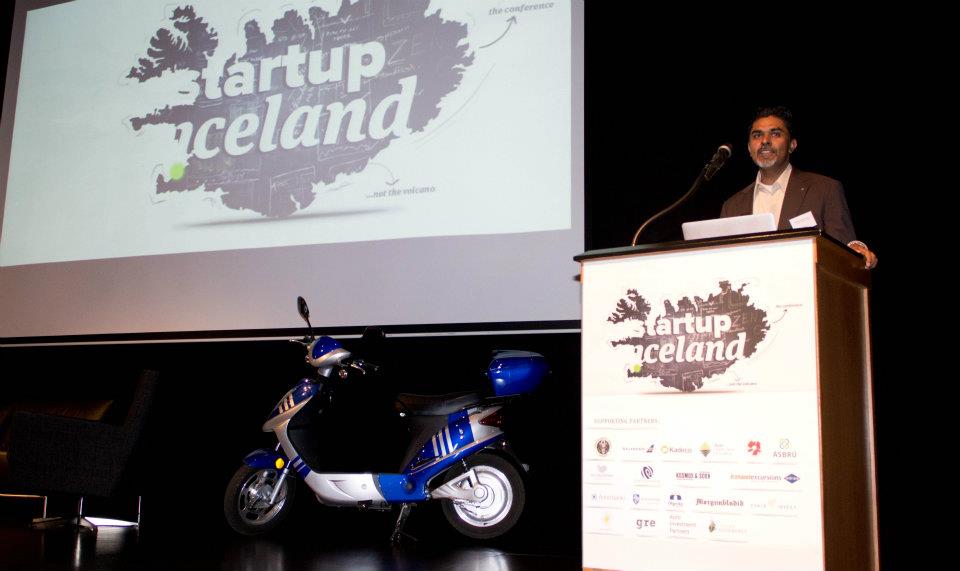
Since October I have read every job ad posted in Iceland, every day. Not by hand; the Startup Iceland jobs database collects them from Alfreð, Starfatorg, Tvinna, Hagvangur and Intellecta and scores each one against the ILO’s index of exposure to generative AI, the work behind Iceland’s changing world of work. But I read a sample of them myself most mornings, because the data only tells you what is there and I wanted to see what is missing.
What is missing is the customer. A typical ad for a specialist in finance, operations, marketing or administration lists six to ten tasks: prepare monthly reports, reconcile accounts, coordinate with suppliers, maintain the CRM, answer enquiries, support the team. Somewhere in the second paragraph there may be a sentence about the company’s values. Nowhere does it say who the company serves, what those people are trying to get done, or how this role helps them get it done. The ad describes a list of activities and calls the list a job.
I think most of us have made the same mistake about our own work. We do a set of tasks every day. The tasks come easily to us after a few years. We are rewarded for doing them well. And so we come to believe that the tasks are the job. They are not, and the difference is about to matter more than it ever has.
The job the customer hired you to do
Clayton Christensen spent the last twenty years of his life on a single question: what job did the customer hire this product to do? His best-known illustration is a fast food chain that wanted to sell more milkshakes. The company had done everything a marketing department does. It segmented its customers, asked them what they wanted, made the shakes thicker, sweeter, chunkier. Sales did not move. Then a researcher sat in the restaurant for a day and noticed that almost half the milkshakes were sold before 8.30 in the morning, to people alone in their cars, who bought nothing else. Those customers were not buying a dessert. They were hiring something to make a long, boring commute bearable and keep them full until ten. The competition was not another milkshake. It was a banana, a bagel, a Snickers bar, and boredom.
Once you see the job, the product changes. Once you see the job, the competition changes too, because anything that does the job is a competitor, including doing nothing at all.
I want to turn that question around and point it at ourselves. A company does not hire a person. It hires a job to be done, and the person is the current best solution it could find. The task list in the ad is the solution as somebody understood it on the day the ad was written. When the cost of doing those tasks collapses, the job does not disappear. The solution does. And the person who confused the two finds out that they were competing not with a colleague but with anything that does the job.
Nobody hired me
In 2010 I could not get a job interview in Iceland. Not a bad interview; not one. I had come to Glitnir in 2006 to run strategic growth, taken the bank from four offices to eleven countries, and then watched it fail in October 2008 along with everything else. I spent the next few months working for the resolution committee, recovering what could be recovered from the bank’s investments in Asia. When that work ended, so did my usefulness as far as the Icelandic job market was concerned. The task list I could put on a CV belonged to a world that no longer existed.
I will not pretend I had nothing. I had three degrees, a network, savings, and a reputation that survived the crash better than the bank did. What I did not have was anyone who wanted to hire what I knew how to do. So I stopped looking for an employer and started looking for a job that needed doing.
The job was obvious once I looked. Iceland in 2010 had founders, ideas, engineers and no community around them. No regular place to meet, no mentors who had done it before, no investors who understood that venture returns follow a power law and that the only way to be in the one company that matters is to be close to all of them. Taleb, Fred Wilson and Brad Feld had written down the theory. Nobody in Reykjavík was applying it.
Startup Iceland was founded in 2011 to do that job, and I want to be precise about what the job was. It was never about my own agency. It was built for anyone who wanted to build their own. What we did was enable people to find each other, share ideas and get mentoring, so that founders could build companies that create value for the world from Iceland. I had started working toward my first investment here, Clara, in 2009, with my own money and my own time, and it became the first Icelandic company acquired into Silicon Valley. I kept doing that: working with founding teams, taking personal risk on the proposition that viable businesses could be built from here. The founders were my customers. I was learning what job they had hired me for by doing it, one company at a time.
The first close of Iceland Venture Studio was in 2019. Eight years after Startup Iceland, ten after Clara. I did not pitch a fund to anyone until I had proof that the model worked and proof that I had a way of working with founders that they valued and would say so. The fund was not the idea. The fund was the product that got built after the job was understood. I think this ordering is the only part of my story that is copyable, and it is copyable by anyone: the research is free, the risk is yours, and the proof comes before the pitch.
The barrier moved
It took me eight years to go from the job to the fund. It took that long because every task on the way had to be done by a person, and mostly by me. I think that constraint has now gone, and I want to be careful about what the evidence says, because the evidence is not what the vendors say.
The cleanest study of generative AI at work so far comes from Denmark, where Anders Humlum and Emilie Vestergaard matched surveys of 25,000 workers in exposed occupations to tax records. Workers reported saving about 2.8 percent of their hours. Almost none of that showed up in wages or hours worked. The time went into other tasks, including new tasks the tools themselves created. The authors’ explanation is the one that matters for this post: if you cannot take on more work or do something more valuable with the hour you saved, the hour is worth nothing to you. The constraint was never the task. It was that nobody had a place to put the time.
Our own data says where that hour is most likely to appear first. Of the 564 jobs open in Iceland on 8 November, 170, or 31 percent, are in occupations where the ILO’s index says generative AI could do a substantial share of the tasks. The other 69 percent are nurses, shop assistants, mechanics, carers and teachers, whose work the models barely touch. So I am not writing about most Icelandic jobs. I am writing about the third where the task list is already being eaten, and about the employers who have noticed: on Tvinna, Iceland’s tech and creative job board, 4 percent of ads mentioned AI in 2019. In 2026 it is 43 percent, and the ads name the tools.


So the question is not whether agents can do the tasks. In Iceland they already do. On 6 May this year Nova launched Kosmos, a mobile company built from scratch on eSIM, 5G and an AI agent that the company describes as its only frontline employee. No call centre, no shops, no plastic SIM cards, no voicemail. A small team runs the company and manages the agents that do provisioning, support, billing and follow-up. The agent is built by Snjallgögn, a company I am an investor in, so read that paragraph knowing I have a stake in it being true. What I can say from the inside is that the tasks a telecom used to employ a few hundred people to do are being done by software, today, for a company with Icelandic customers paying Icelandic króna.
The cost of the tasks has collapsed. What has not collapsed, and cannot, is the cost of knowing which job the customer hired you for. That is the only expensive thing left, and it is the thing the task list never told you.
Asked from inside
Kosmos did not begin as a strategy deck. It began with an employee. Last autumn Nova’s management trusted Sverrir Hreiðarsson with the task of building a new telecom around self-service, AI and the lowest price in the market. He has written about what they removed: the cables, the voicemail, the expensive service numbers, the ringback tones, the call centre, the shops. Everything a telecom does out of habit rather than because a customer hired it to.
That is the milkshake researcher sitting in the restaurant, except he was an employee of the company whose product he was questioning. He asked what job a customer would hire a mobile company for if every unnecessary thing were removed, and the answer was a different company. Nova now competes with itself in the consumer market on purpose.
I tell this story because the usual objection to everything I have said so far is that only founders and investors get to ask the customer question. Everyone else has a manager, a process and a task list, and no permission. Sverrir had a manager and a task list. The question did not need permission. It needed to be asked well enough that somebody with permission wanted to hear the answer.
What I do not know about my own job
I should admit something. When I started writing this I wrote that for a seed investor, the job the founder hires you for is the seed cheque. I looked at that sentence for a while and realised it is exactly the mistake I am accusing everyone else of. The cheque is the task. Any of a dozen people can wire money into a company. Nobody hires a seed investor for the wire transfer.
So what did the founders hire me for? Seventeen years in, counting from the day in 2009 I started preparing to invest in Clara, with the customer in the room every week, I am not certain. The founders have always given me feedback, and the thing they come back to is not the money. It is the hour a week where we talk openly about everything that is hard about building a company, where I am fully present, and where I am a sounding board rather than a critic of the mistakes they have already learned from. Most of the founders I have worked with are still in my life long after the investment stopped being the reason, and I think that is because they came to trust that I cared about what they were building at least as much as they did.
If that is the job, then it is a job that an agent is a long way from doing, and it is also a job I could do better. I keep asking. I do not expect to stop. There is no end to what can be done to improve any company, and that includes the one-man company that is me.
Five questions for Monday morning
If you take one thing from this, take the exercise rather than the argument. It takes an hour. Do it on your own role, not your company’s.
- Who is my customer? Not the company. The person, inside or outside the firm, whose problem goes away when I do my work well. Name them. If you cannot name them, that is the finding.
- What did they hire me to do? Write it as the customer would say it, in one sentence, without using any word from your task list. The milkshake was hired to make a commute bearable. What was I hired to make bearable, possible, faster, safer, cheaper or less lonely?
- Which of my tasks are the job, and which are the current solution? Go down the list. For each task, ask whether the customer would notice if it were done by a machine tomorrow. Be honest. Most of mine, they would not.
- What would I do with the hours? This is the question the Danish workers were never asked. If the solution-tasks went away next quarter, what would I do for my customer that nobody is doing now? Could we build a better product? Could we serve them better, add more value, delight them, delight the partners and stakeholders around them? These questions get pushed back every week because of busy work, and the busy work is about to go.
- Who needs to hear the answer? Sverrir’s question was heard because he asked it to someone who could act on it. Write down who that is for you and what you would need to show them before they would listen. Then go and get that proof. It is cheaper than it has ever been.
If you are not employed, the exercise is the same, with one change: the customer in question one is whoever has a job that nobody is doing. That was me in 2010. It is somebody reading this in 2026.
Agency is the constraint now
I am not going to tell you that individual agency is the only thing that matters. Capital matters, markets matter, luck matters, and I had more of all three than most people who could not get an interview in 2010. What I will say is that agency has become the binding constraint, the one that decides whether the others can be used at all. For most of the last century the constraint was the cost of doing the tasks. You needed an organisation to afford the people to do them, and so the organisation got to define the job and hand you the task list. That is over, or close enough to over that the difference is a matter of years.
What remains is the question. Who is my customer, what did they hire me for, and what would I do for them if the tasks took care of themselves? Asking it is not a privilege of founders. It is the job now, for every one of us, employed or not. The people who keep asking it will be hired by the jobs that exist. The people who keep doing the tasks will find out that the tasks were never theirs to keep.
Sources and disclosure
- Clayton M. Christensen, Taddy Hall, Karen Dillon and David S. Duncan, Competing Against Luck (2016), for the jobs-to-be-done framework and the milkshake study.
- Anders Humlum and Emilie Vestergaard, Large Language Models, Small Labor Market Effects, NBER Working Paper 33777, May 2025, revised October 2025.
- Nova Klúbburinn, Kosmos launch announcement, 6 May 2026; mbl.is, Farsímafélagið Kosmos nýtir gervigreind Snjallgagna, 13 May 2026; Viðskiptablaðið, Lággjaldafélag Nova hefur starfsemi í dag, 6 May 2026.
- Startup Iceland, Jobs and Iceland’s changing world of work.
I am an investor in Snjallgögn, which built the AI agent Kosmos runs on, through Founders Ventures. I have no position in Nova Klúbburinn. Clara was my own investment in 2009, before any fund existed. Iceland Venture Studio, where I am Managing Director, invests in early-stage Icelandic companies, and the founders I describe in this post are its portfolio founders and others I have worked with through Startup Iceland. The views here are mine.
Discover more from Startup Iceland
Subscribe to get the latest posts sent to your email.
