
I read Aswath Damodaran’s post on the Anthropic prospectus this week and I have not been able to stop thinking about it. Anthropic filed on 26 October, the document runs to 416 pages, and Damodaran did what he always does, which is ignore the run-rate chatter, build a story, put numbers on the story and arrive at a value, in this case $1.475 trillion against an offer range of $1.5 to $2 trillion. I am not going to redo his valuation, he does that better than anyone alive. What I want to do is use what the filing tells us about the business of AI, because I strongly believe most people have this business wrong, and for a country whose main asset is electricity, getting it wrong is expensive.
One line in the filing matters more than the valuation. In early 2025, compute cost Anthropic more than 250% of its quarterly revenue. By the second quarter of 2026 that number was 48%. The company has $114 billion in cash, expects to raise around $100 billion more in the offering, and has signed compute commitments of more than $600 billion. Its bonds are rated BB+. Revenue in the first half of 2026 was $16.3 billion, up about fourteen times on the same period a year earlier, and growth slowed in the third quarter.
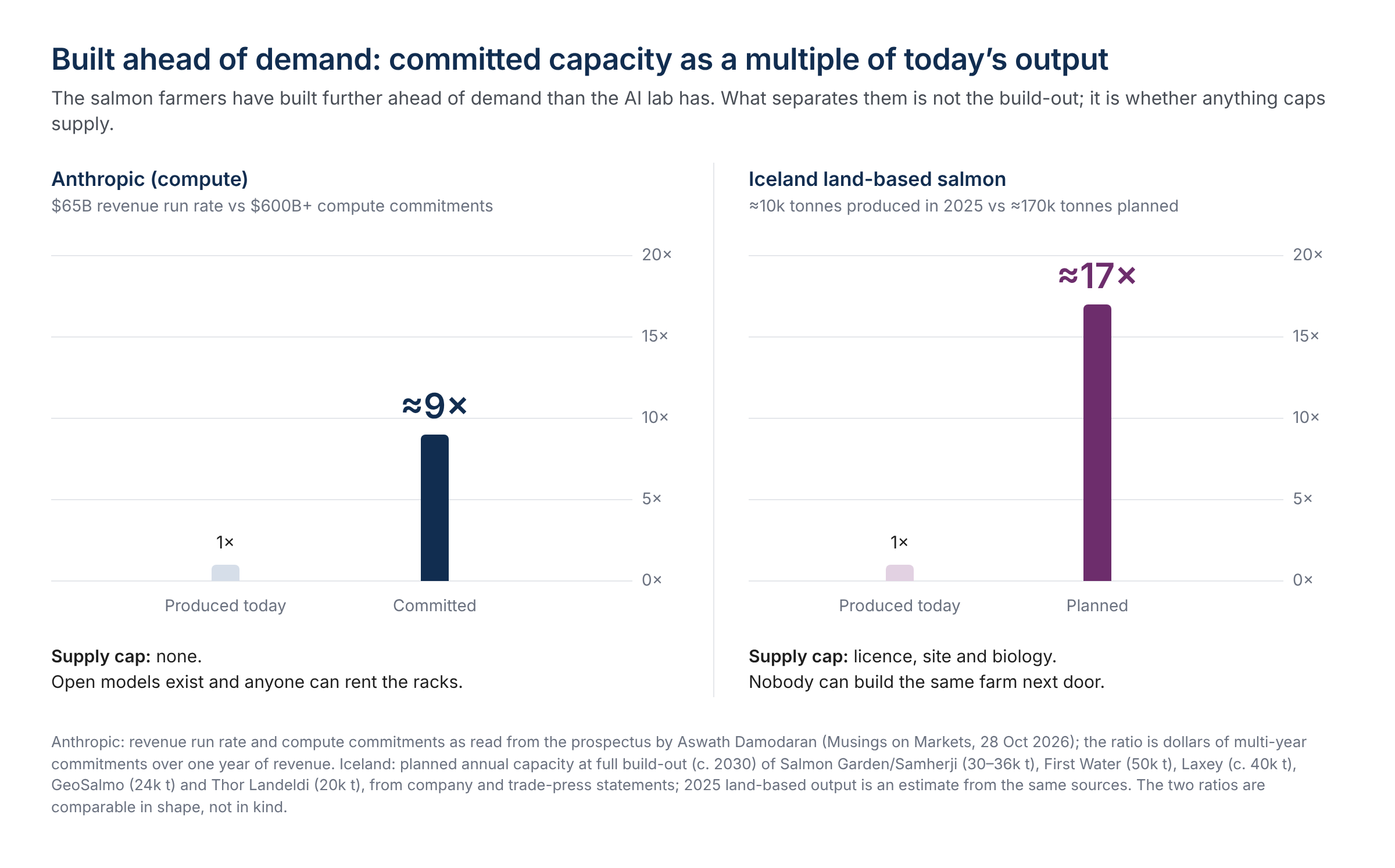
Read those numbers together and tell me you are looking at a software company. Software companies do not have a line for the cost of running the product that was once two and a half times revenue, they do not carry purchase obligations of nine times their revenue run rate, and they do not have junk-rated bonds. The business that has all of those things is a business that has to build capacity before it can sell anything, and I would argue that Icelanders understand that kind of business better than almost anyone, because we have lived through both versions of it.
Marginal cost came back
For about twenty-five years, from the first browser to the first chatbot, software was the only industry in history where the next customer cost nothing. You wrote the code once and served it a billion times. Capital was fuel for distribution and sales, not for the product itself. That is why a founder with a laptop could reach scale, and why venture capital, which is small money by the standards of infrastructure, could fund the companies that came to dominate the world.
AI ended that. Every answer Claude gives costs silicon and kilowatt-hours. The 48% line in the prospectus is a marginal cost line, and software never had one. Anthropic uses software, and it solves software problems better than most software ever did, but the thing it sells is produced on physical machines that consume real power and have to be paid for whether or not a customer shows up. That is the definition of a capacity business.
Damodaran makes the same point in his own language. He assumes Anthropic will have to invest about one dollar for every three dollars of new revenue, and he treats the compute commitments as debt, because the balance sheet does not show them as assets or borrowings. The capital intensity is hidden in a footnote about purchase obligations. If you read an AI company’s income statement without reading that footnote, you are reading fiction.
So I don’t think the interesting question is whether AI is a capacity business, the filing settles that. The question is what kind of capacity business it is, and here Iceland has two answers sitting in plain sight.
Salmon farm or airline
Iceland has two capacity businesses it understands in its bones, and they teach opposite lessons.
A salmon farmer puts smolt in the water two years before the fish is sold. The cages, the feed barges, the wellboats and the processing plant are all paid for before the first kilo of revenue. The product is a commodity. And yet Mowi, SalMar and Lerøy have made money for two decades, through sea lice, algae blooms and price crashes. The reason is not the technology. It is the licence. Biology and regulation cap how much salmon can be grown in a fjord, so supply cannot flood the market no matter how much capital wants in. A capacity business with a cap on supply earns a return on its capacity.
An airline is the other kind. Wow Air leased its fleet, funded growth with bonds, and ran a hub model that depended on transatlantic passengers who could choose any carrier. It stopped flying in March 2019. Play leased its A320neos, raised equity round after round, and never reached the scale its cost base needed. It stopped flying in September 2025. Both built capacity before demand, like the salmon farmer. The difference is that nothing caps airline supply. Anyone can lease an A321. A seat from Keflavík to Boston is a pure commodity, and the capacity is rented in dollars while the revenue arrives in whatever currency the passenger happens to hold. A capacity business with no cap on supply earns nothing on its capacity, and in a downturn the lessors take the planes back.
I have come to think that this is the whole test, and it is not the one people usually apply. It is not whether a business has to build capacity ahead of demand, almost every real business does. It is whether something stops everyone else from building the same capacity next door. If the answer is yes you are a salmon farmer, and if the answer is no you are an airline, and it does not matter how good your technology is.

The prospectus reads like an airline
Apply the test to the filing. Anthropic rents its capacity rather than owning it; the $600 billion of compute commitments are aircraft leases by another name, and at roughly nine times the revenue run rate they are a bigger lease book, relative to revenue, than any airline has ever carried. The price of its product falls faster than any airfare ever did. Nothing caps supply, because open-weight models exist and the prospectus itself admits that some customers moved to cheaper ones in the third quarter. And the thing that differentiates the product, being at the frontier, decays in months.
Damodaran’s valuation is built on the opposite assumption. His base case has 75% of Anthropic’s revenue coming from a premium tier earning something like 40% margins, with only a quarter in a mass market earning 10%. That is the assumption that Anthropic is a salmon farm with a licence. Change the mix and the value collapses; his own worst case is negative equity and the company does not survive. His range, from minus $373 billion to plus $4 trillion, is not a weakness of his model. It is the honest distance between the two businesses the filing could turn out to be.
There is one more thing the airline comparison explains, and it is the part people find strangest about the filing. Anthropic has five classes of shares, a trust that appoints the board, and founders who hold 50.1% of the votes. Damodaran calls it self-serving and says institutions have accepted it anyway. Why would capital accept that? Because the capital that matters did not come in through the share register. It came from Amazon, Google and Nvidia, who are also the suppliers of the capacity. They do not need board seats. They get paid through the compute contract. The lessor does not need a vote at the airline’s annual meeting; he owns the planes. When Wow Air ran out of money, its shareholders held the votes and its lessors held the aircraft, and it was the lessors who decided.
Capital is back, and it already owns the capacity
I have believed for a long time that three levers move the world: human agency, technology and capital. A person decides to build something; technology multiplies what one person can do; capital buys what technology cannot. For a generation, technology was the longest of the three, and it made human agency longer with it. A founder with an idea and a laptop could out-lever a bank, because the lever in his hand cost nothing to pull. I now think the pendulum has swung towards capital, and the prospectus is the evidence.
Start with the obvious question. Why does a company with $114 billion in cash raise another $100 billion? Not for a war chest. Work the numbers: $600 billion of commitments, one dollar of reinvestment for every three of new revenue, a path to a trillion in revenue. That is something like $300 billion of reinvestment over a decade. $214 billion is two or three years of the schedule. The company is raising $100 billion because it cannot stay in the game without it. And at that ticket price, the number of companies that can enter the game is in single digits.

That is what it means for capital to decide the winners. Not that capital sits on the board; the founders made sure it does not. It means that only those who can raise two hundred billion dollars get to compete, and only a handful of balance sheets in the world can write those cheques: three or four hyperscalers, one chip company, a few sovereign funds. Those balance sheets have already chosen. OpenAI and Anthropic are the winners because Microsoft, Amazon, Google and Nvidia funded them, and those same companies sell them the capacity the money is spent on. Capital and capacity are in the same hands, and that fusion is the decider.
The open-weight models look like the exception and are not. Open weights made the technology cheap to acquire. They did nothing to the cost of serving it to a billion people. That still takes the same racks, the same power, the same land and the same permits, and land, power and permits can only be bought with capital. The technology is free. The business is not.
We have seen this shape before. The railway shareholders of the 1840s lost most of their money and Britain got railways. Global Crossing went bankrupt and Google got cheap fibre. Wow Air failed and Iceland got a tourism industry. In every capital-intensive technology wave, capital overbuilds capacity, the capacity-builders earn thin margins or go bust, and the value flows to two places: the owner of the scarce input, and whoever uses the cheap capacity afterwards. Today the scarce input is chips, and Nvidia’s margins say so. Next it is power, land and cooling.
What this means for founders
I have spent seventeen years telling founders in Iceland that they can build something of scale from here with very little capital, and I had good company in saying it. Fred Wilson wrote about it, Brad Feld built a whole community philosophy on it, and I quoted both of them more times than I can count. The reason it was true is that the marginal cost of software was zero and distribution was a browser away. I now have to revise that advice, and I want to be careful about how, because the easy version of the revision (“raise more money”) is wrong.
The layer where a founder used to win with thin capital was the application layer: take a capability, wrap it in a product, sell it to a customer the big company was not paying attention to. That layer is now the most exposed place to stand. A lab with real marginal cost and $600 billion of commitments has to grow into every adjacent market to cover them, and the prospectus says so plainly: agents that replace the software they run on, and entry into fields like pharmaceuticals. Whatever a founder builds on top of a model is on the lab’s list of next features. The thin-capital product is not a company; it is a roadmap item for someone else.
So the moat has moved. For a generation the moat was code and distribution. Code is now the thing AI consumes. The moat is whatever the lab cannot buy with its $214 billion: a licence, a permit, a fjord, a relationship with a regulator, data that only exists because you run a physical operation, and physical capacity that is already built in a place where it cannot easily be built again. Those are the things that cap supply, and a capped supply is the only thing that lets a capacity business earn a return.
That gives founders three honest positions.
- Own the scarce input. Be the party that holds the licence, the power contract, the land or the permit. This is a capital-intensive position and it is why most founders will not be able to take it alone. It requires the kind of money pension funds and infrastructure investors deploy, not the kind venture funds deploy. A seed fund cannot buy a fjord. What a seed fund can do, and what ours has done since the beginning, is find the person who will.
- Use the cheap capacity. After every overbuild, the winners were the companies that consumed the stranded capacity at a fraction of its cost. Google on cheap fibre, tourism on cheap seats. Intelligence is becoming the cheapest input in the economy. The founder who wins here does not build a model and does not wrap one. They apply cheap intelligence to a capacity business they already own the licence to: a salmon farm, a fishing fleet, a geothermal field, a hospital. Power into protein, with intelligence on top. This is the position I would take, and it is why Blue Nova looks at the ocean rather than at the model.
- Be the airline. Lease the capacity, sell the commodity, hope for scale before the money runs out. This is where most AI startups are today, whether they know it or not. They rent compute by the token, sell a product with no cap on supply, and compete with the lab that sells them the compute. Some will reach scale. Most will end the way Wow and Play ended, with the lessor holding the assets.
The test for a founder is the one I gave for the business: does something stop everyone else from building what you are building? If the answer is only “we are faster” or “our model is better”, you are an airline. If the answer is a licence, a permit, a physical asset or a regulator, you are a salmon farm, and the capital that funds you will be patient capital, because it has to be.
Which brings me to the lever I have not dealt with yet, and the one I care most about. Capital has swung back, technology has become an input rather than a moat, and what is left is the one thing capital has never been able to buy and technology has never been able to replace, which is the will of a person who has decided to build something. The thesis of the funds I run has not changed in a long time: we invest in human agency and in technology, and the most valuable thing a seed fund does is back the first of those, the mission-driven founder. I have watched that will in action for seventeen years, through a banking collapse, a pandemic and two airline failures, and I can assure you that I have not seen anything that overrides it, not capital, not a better model, not a larger competitor. I have seen it fail, often, but I have never seen it bought.
The prospectus proves the point from the top. The founders of the labs kept 50.1% of the votes against $214 billion of capital because they were the one input the capital could not manufacture. That is human agency holding its ground against the longest capital lever ever assembled. The uncomfortable part is what happens below them. An ordinary founder building a capacity business will give up more of the share register than founders have been used to giving, because the capacity costs real money and the money wants a return. But the share register is not the lever. The person is. A founder with a mission, a licence and cheap intelligence has all three levers in hand, and the capital that joins them is a passenger, however large its cheque.
Iceland’s choice
Two weeks ago I wrote that Iceland has never allocated power; it has only ever built it for someone. Kárahnjúkar was built for Alcoa. Every large plant in the country was built against a named buyer on a long fixed-price contract. The prospectus tells us who the next named buyer will be and what kind of company it is.
It is an airline. It rents its capacity, it carries a BB+ rating, it has commitments of nine times its revenue, and it will go looking for power the way Wow went looking for aircraft. A forty-year fixed-price power contract to that buyer is the lessor’s position: steady while the lessee pays, and worth nothing the day the planes come back. We know what that looks like. We have the empty hangars.
I do not think Iceland should refuse to sell power to the AI industry. I think it should understand which side of the equation it is on. The prospectus says the scarce input, the one thing the $214 billion cannot manufacture, is firm, cheap, clean power in a place where it can be delivered. Iceland is one of perhaps five places on earth that has it. That is a licence. It is the salmon farmer’s position, not the airline’s, and it should be priced like one: not a fixed tariff to a tenant whose bonds are junk, but a share of what the kilowatt-hour earns.
And the better use may not be to rent it at all. The post before this one argued that power into protein earns four to seven times what power into metal earns for the community that provides it. Add cheap intelligence to the protein business and the multiple goes up. A land-based salmon farm run on Icelandic power, managed by models that cost almost nothing to run, selling into a market with a biological cap on supply, is a capacity business where Iceland holds the licence, the input and the product. The AI lab is a capacity business where Iceland would hold a tariff.
So the pendulum has swung back to capital, and I don’t think it swings back again for a while. The question I keep coming back to is what a small country with a large amount of power does about that. Does it want to be the capital’s tenant, or its landlord? And is there a version, this once, where it would rather own the farm? I don’t have the policy answer, that is for people who are paid to write policy. My 2 cents is that the prospectus has told us what the next buyer looks like, and we should read it before we sign anything.
Sources and disclosure
- Aswath Damodaran, The Anthropic Prospectus Arrives: My (but not the) IPO valuation, Musings on Markets, 28 October 2026. All prospectus figures above (revenue, compute as a share of revenue, cash, commitments, rating, share classes, valuation inputs and range) are taken from his reading of the filing.
- Fortune, Anthropic’s IPO prospectus shows $16.3 billion in revenue, 26 October 2026.
- Startup Iceland, We Have Never Allocated Power. We Have Only Ever Built It for Someone, 16 October 2026, and More Power Will Not Make Us Wealthy, 13 October 2026.
I run Blue Nova Ventures, which invests in the Blue Economy, including aquaculture. Blue Nova holds no position in Anthropic or in any company named in this post. The $300 billion reinvestment figure and the nine-times-revenue comparison are my own arithmetic from Damodaran’s inputs, not figures from the filing.
Discover more from Startup Iceland
Subscribe to get the latest posts sent to your email.
