
The jitters
Every conversation I have had this autumn about AI ends in the same place. A founder worries about layoffs he has not announced. An executive worries about being left behind by a competitor she cannot name. An employee worries about both. Almost nobody in these conversations has looked at what is actually being hired for, or has sat with the tools long enough to know what they can and cannot do. The fear is real. The looking has not happened.
So we looked. Since 17 October, Startup Iceland has been collecting every job advertised on Alfreð, Starfatorg, Tvinna, Hagvangur and Intellecta into our jobs research database. A job posted on several sites counts once. Each posting gets an ISCO-08 occupation and a score from the ILO’s 2025 index of occupational exposure to generative AI, and the running figures are on our Iceland’s changing world of work page. The daily series is a few days old, so I am not going to pretend it shows a trend. But a snapshot of 618 open jobs already says something the headlines do not.
What Iceland is hiring for
Most of it is work generative AI cannot do. Of the 618 jobs open on 18 October, 428 (69%) sit in the ILO’s “not exposed” or “minimal exposure” bands. The most advertised occupations include early-childhood educators (32), nurses (21), machinery mechanics, home-care workers, car mechanics, primary-school teachers, specialist doctors and cooks. The economy is asking for hands, presence and judgement.

The remaining 186 jobs (30%) are in an exposed gradient, and only 15 are in the highest one. The ILO is explicit that its index measures technical potential, not expected job loss, and I will stick to that. A nurse who dictates her notes into an assistant is still a nurse. A developer whose boilerplate is written by Claude Code is still a developer, and probably a busier one.
Employers want people who use AI, not AI people
Twenty-two of the 618 jobs (3.6%) mention AI. Four of them are roles whose purpose is to build or apply it. The other eighteen are ordinary jobs that now expect you to work with it: “experience with AI tools”, “using AI for analysis and presentation”, “interest in using AI and automation at work”. Named tools: Claude Code five times, Microsoft Copilot twice, Cursor, Codex and Claude once each.
That is the signal I care about. AI is not arriving in Iceland as a department. It is arriving as a line in the requirements, the way Excel did thirty years ago. For a while it will be worth stating. Then it will be absurd to state, the way “comfortable with email” is absurd now.
In tech, the shift has already happened
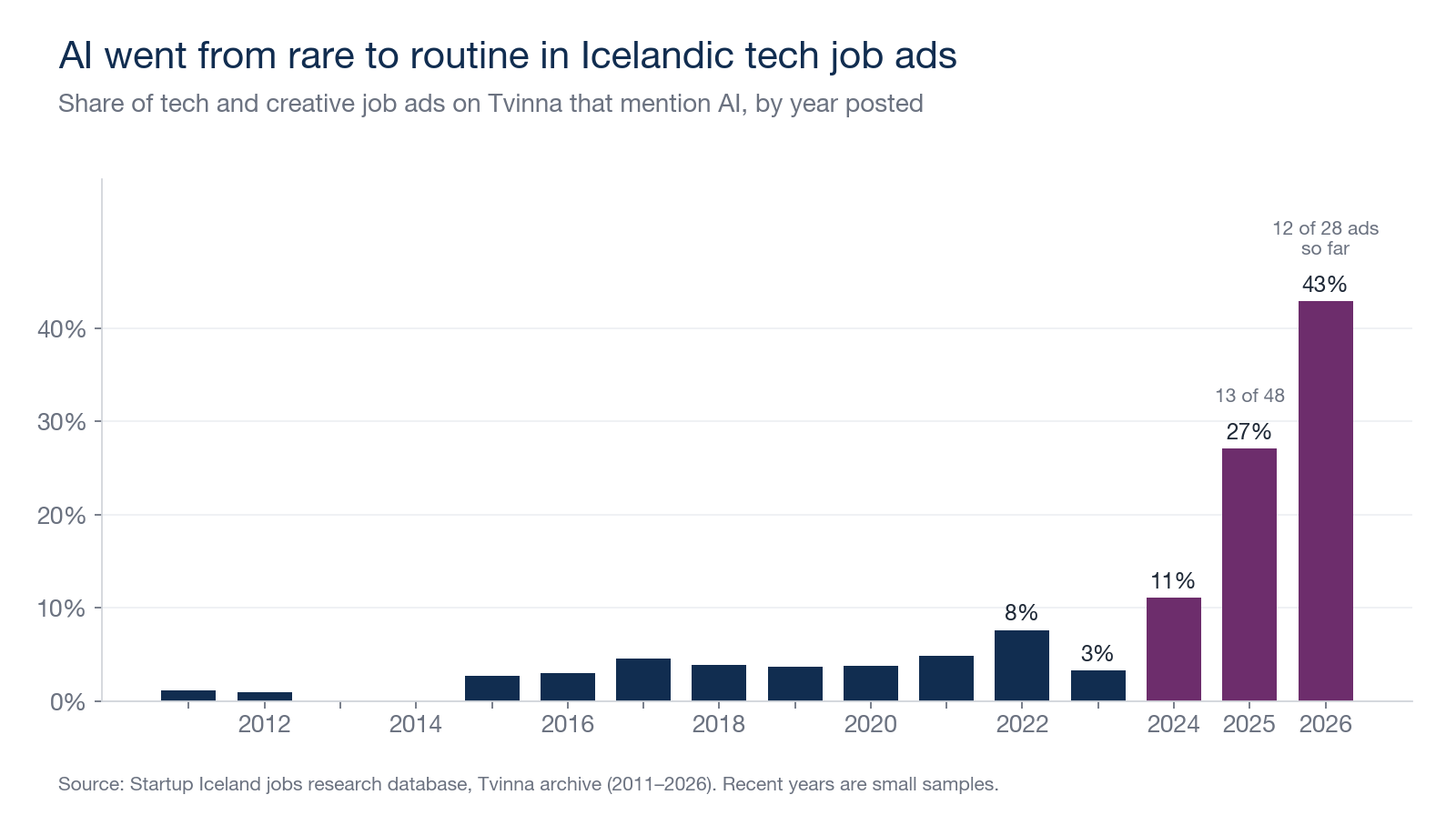
Tvinna’s archive of tech and creative jobs goes back to 2010. From 2011 to 2021, between zero and five percent of its ads mentioned AI in any given year. Then: 7.6% in 2022, 3.3% in 2023, 11% in 2024, 27% in 2025, and 43% so far in 2026.
Two caveats before anyone quotes that. The recent samples are small: 13 of 48 ads in 2025, 12 of 28 this year. And Tvinna’s own volume has fallen from 264 ads in 2022 to 48 in 2025, so part of what we see may be Tvinna’s share of the market rather than tech hiring as a whole. But the direction is not ambiguous. In roughly two years, AI went from a curiosity to something that appears in nearly half of Icelandic tech and creative job ads. The rest of the market, I expect, follows the same curve a few years behind.
The jobs that go are not the ones we expect
The public fear is of the robot taking the nurse’s job, the mechanic’s, the teacher’s. Our data says those are the jobs Iceland is advertising most. What changes first is inside office work: 29 of the 33 clerical jobs in our count are exposed, and 64 of the professional ones. And it changes by task, not by job. Drafting, summarising, first-pass analysis, routine code, formatting the report. Not the job; the hours inside the job.

This is why “replacement” is the wrong frame, and also why the moment feels so unsettling. When a whole job disappears, everyone can see it. When a third of a job disappears, nobody announces anything. The person is still there, the output is still there, and the company quietly decides what to do with the freed hours: ask for more, or need fewer people. That decision, not the technology, is where jobs are won or lost. And it is being made right now, in hundreds of Icelandic companies, mostly without anyone naming it.
Two paths
The first path treats AI as a cost line. Count the hours, cut the heads, buy the licences. It works on a spreadsheet for about a year. What you lose is the people who knew how the work was actually done, and with them the ability to redesign it. You end with the old process run by fewer, more tired people, and a tool that nobody owns.
The second path treats AI as the reason to rebuild how the company works. Give people the tools and the time, let them find the tasks that collapse, and then redesign the role around what is left, which is usually the judgement, the relationships and the physical work. The company gets the productivity and keeps the knowledge. The employee gets a bigger job, not a smaller one.
I have no Icelandic data yet on which path firms are taking, and I will say so plainly. My guess is that most have not chosen, and that is the real source of the jitters. A company on either path knows what it is doing. A company on neither is waiting to be told, by a competitor or by its own staff, and that is a bad way to find out.
What to do
If you run a company. Pick three recurring tasks that eat professional hours, give a tool to the people who do them, and measure for a month. Not a pilot committee; the actual people, on the actual work. Then redesign the role around what the month showed, and write the new expectation into the job description. The market already does this: AI fluency belongs in every role, not in a new title. Spend on training before you spend on licences. A licence nobody uses is the most expensive software you will buy this year.
If you work for one. Spend an hour a day for a month with one tool on your own work, not on demos. Learn where it fails, because that is where your judgement is worth paying for. The people getting hired right now can say exactly what AI did and did not do for a given task. That sentence is the new CV line.
If you are a founder. Build for the 69%. Every lab in the world is competing to automate the exposed jobs. The unexposed ones, care, trades, teaching, hospitality, are where tooling is thin, the need is real, and Iceland is hiring most. Making a nurse or a mechanic more productive is a better business than making another analyst redundant.
What we cannot say yet
Our daily series is days old, so nothing here is a trend across the whole market. Against Statistics Iceland’s vacancy survey (3,540 vacancies in Q2 2026) we see about one job in six, and the coverage is uneven: strong in public administration, education and health, ICT and finance, weak in construction and professional services. Hagstofa counts positions, including ones never advertised, and same-quarter comparisons start in 2027. We have nothing on pay, and nothing on which firms are cutting staff because of AI. Exposure is not job loss; the ILO says so and so do I.
What we do have is a live count of what Iceland is asking for, updated every day, and it is public at startupiceland.com/changing-world-of-work. I am investing in keeping it that way. The collection will keep running, the archive will keep growing, and the method will stay open, so that in a year, and in five, we can see for ourselves how work in Iceland is changing instead of guessing from someone else’s headlines. As the series grows we will publish what it shows, including the parts that contradict this post.
Data: Startup Iceland jobs research database (Alfreð, Starfatorg, Tvinna, Hagvangur, Intellecta), snapshot of 18 October 2026. Exposure scores: ILO Refined Global Index of Occupational Exposure to Generative AI (Gmyrek et al., ILO Working Paper 140, 2025, CC BY 4.0).
Discover more from Startup Iceland
Subscribe to get the latest posts sent to your email.
