
Startup Iceland · October 2026
Disclosure: I run Blue Nova Ventures, a venture fund that invests where technology meets the blue economy and it holds no stake in any company named here.
Two weeks ago I wrote that more power will not make us wealthy. Since then the chief executive of Landsvirkjun has resigned, his finance director has followed him, and the government’s first industrial policy, published in April, has been open on my desk the whole time. One thought kept returning, and it is the subject of this piece.
Iceland has never had to decide who gets its electricity. That sounds wrong for a country whose modern economy runs on power, so I will be precise. We have decided, many times, to build a power plant for a particular customer. We have never sat down with a fixed amount of electricity and a queue of people who want it, and chosen between them. That is about to change, and neither our institutions, nor the new policy, nor, as of this month, the people running our power company are ready for it.
How we have always done it
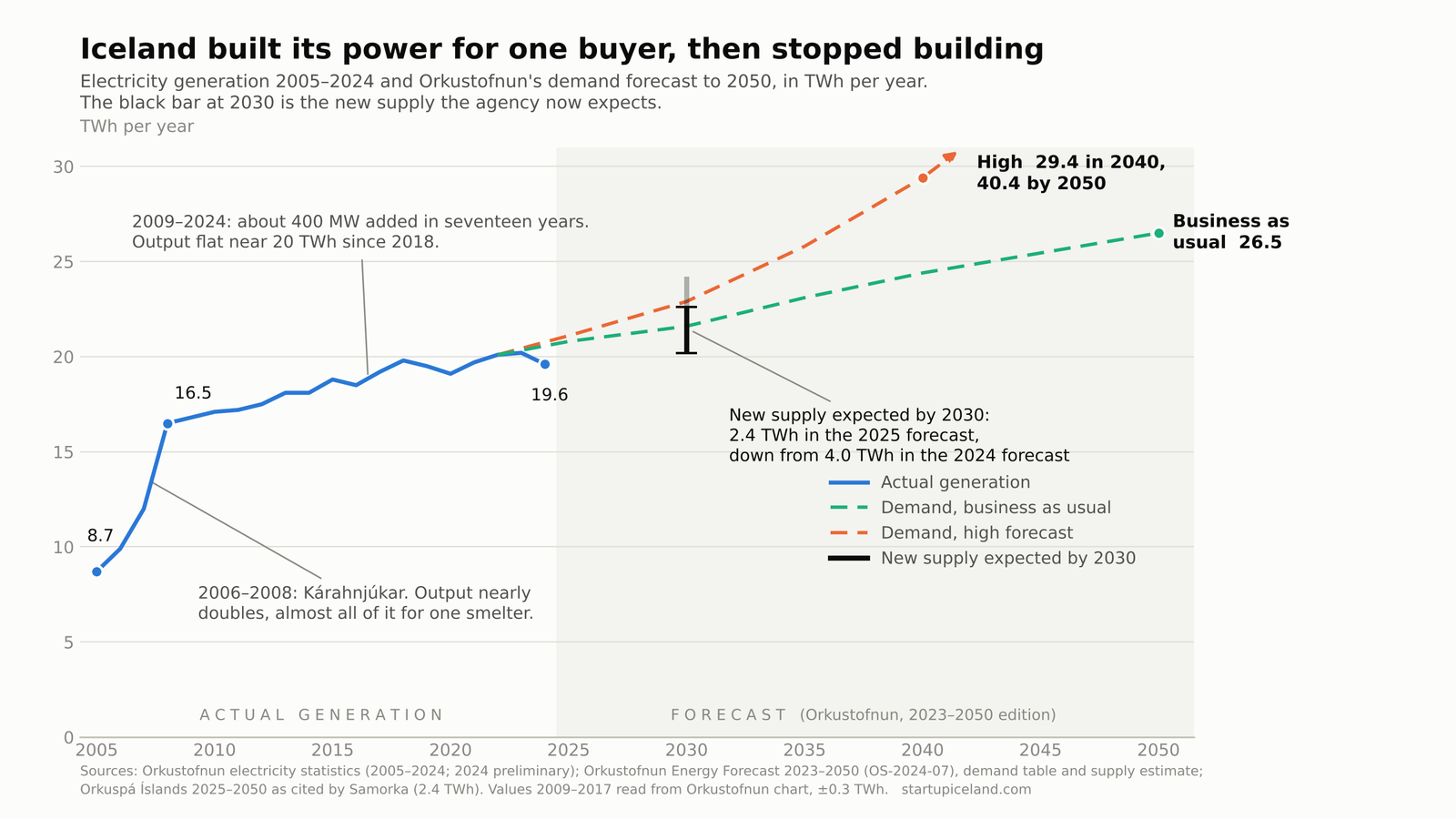
I came to Iceland in 2006 to join Glitnir. Hellisheiði came online that year; Kárahnjúkar the year after. In my first three years here the country nearly doubled its electricity output, from under ten terawatt-hours to over sixteen, and almost all of the increase went to one aluminum smelter in the east. At the time it looked like what a small country with big rivers was supposed to do.
Consider what Kárahnjúkar was as a decision. The customer was Alcoa. The price was negotiated with Alcoa. The dam was sized for Alcoa. The plant, the buyer and the tariff were settled together in 2003, and then everyone went off and built it. Nobody had to ask what else the power might be used for, because the power did not exist until the buyer did. Go back through the history, Búrfell and the Straumsvík smelter in 1969, Blanda, Sultartangi, and the pattern holds. Power in Iceland has been something you build for someone. It has never been something you have and then hand out.
That worked while the rivers were many and the buyers few. It stopped working around the time I arrived, and nobody noticed, because the last big project was still coming online and it looked like abundance.
The seventeen quiet years
Since 2009 we have built Búðarháls, Þeistareykir, Búrfell II and, last month, Vaðölduver, the first wind farm. About 400 megawatts in seventeen years, against the 1,100 already decided when I landed. For nine of those years Alþingi adopted no rammaáætlun at all. Hvammsvirkjun, the one large hydro project left in the pipeline, had its permit annulled by a court in 2025 after two decades of process. The grid can move about 100 megawatts between regions, which is why the large users in the east were curtailed in 2024 and 2025 when the reservoirs ran low.
The obvious reply is that plenty is permitted, so build it. The current rammaáætlun allows 9.3 terawatt-hours a year of new generation. Three-quarters of it is geothermal, and the reviewers of Orkustofnun’s own forecast note that new geothermal “usually takes 15 years from first exploratory drilling to start-up.” Of the twenty-odd projects the agency listed as possible before 2030, four had a confirmed grid connection.
So the forecast keeps shrinking. Orkustofnun’s 2024 edition put new supply at “up to 4 TWh by 2030.” The 2025 edition cut that to about 2.4, a reduction of 37.5%, and Samorka observed that even that figure holds only “ef allar framkvæmdir og leyfisveitingar ganga upp án tafa.” Then there is the agency’s own sentence: the new supply “can be sufficient for large-scale energy transition projects in 2030 if it is not allocated to other projects.”
If it is not allocated to other projects. For the first time in our history the question has been put the other way round. Not: who shall we build for? But: we have this much, and who gets it?
What 2.4 terawatt-hours is
The arithmetic deserves a moment, because most people have not done it. Iceland used 20.1 TWh in 2022. Orkustofnun’s business-as-usual case puts that at 21.6 in 2030. Set 2.4 of new supply against 1.5 of new demand and the books appear to balance. That is the comforting reading, and it fails on what business-as-usual assumes: no new large user at all. No new smelter line, no data-centre campus, no e-fuel plant, no cluster of land-based farms. It contains the cars and the ships going electric and ordinary households and businesses growing, and nothing more. The forecast’s own reviewers said it “would be more correct to name the Business as Usual forecast as a low forecast.”
So the 2.4 covers what we have already promised. Anything new must push something out of that baseline, or wait.
What do new things cost? Alcoa Fjarðaál draws about 4.6 TWh a year. A 300-megawatt data-centre campus running flat out draws about 2.6. An e-fuel plant, by Orkustofnun’s reckoning, arrives in 2 TWh steps. A 50,000-tonne land-based salmon farm takes between 0.3 and 0.5. The decade’s entire new supply, then, is one data-centre campus, or half a smelter, or one e-fuel plant, or six to eight large farms, or the cars and the ships. Pick one.
The queue is forming, and compute is at the front of it. Every company training or serving AI models wants the cheapest clean power on earth, and Iceland is on the shortlist. I am not against hosting it. But a smelter put several hundred people to work in Reyðarfjörður for a generation, and a data centre employs a few dozen where it sits and books its value wherever the model is sold. This is the first buyer to arrive at a door we have never had to guard, and every habit we bring to that door was formed in a world where the buyer and the plant were the same decision.
Whose job is it?
I went looking for who decides. Here is what I found.
Orkustofnun knows the question exists. Its 2024 forecast records, under Disclaimers, that “there is uncertainty regarding the extent to which new electricity production will be allocated to energy trading or other large-scale consumption,” and that “the dimensions of current contracts for power consumers have remained constant over time.” The agency responsible for our energy security is saying it does not know who will get the new power, and that the big contracts have not changed shape in living memory. It says so in a footnote, because deciding is not its job.
Atvinnustefna Íslands, the industrial policy, deserves a fair reading. It is a serious document and the first of its kind. It names the right problems: five flat years of GDP per head, a narrow export base, too few engineers, electricity generation growing too slowly. It says a fair share of the value from our natural resources should accrue to the nation, and I agree. Then it lists metals, data centres, aquaculture and renewables as growth priorities, enters electricity generation as an indicator that should go up, and never says in what order those four get the power or by what test. Its four energy measures are about permitting speed and grid works. There is no page on allocation. The old habit shows: the policy assumes generation is the question and the power will find its user.
Someone has been choosing all the same, because the power has been going somewhere. For seventeen years that someone was Hörður Arnarson. He published a ranking, and it is worth setting out in full: households and electrification first, data centres and innovation second, existing large users third, new heavy industry fourth, hydrogen and cable exports last. He held a price line that brought large-user tariffs to Nordic levels and paid down nearly two billion dollars of debt along the way. Look at the list again. It is an allocation policy. A company wrote it, a company applied it, and nobody voted on it. We outsourced the most consequential industrial decision in the country to the chief executive of a state utility, and he did it well enough that nobody noticed it had been outsourced.
Now he is gone. On 1 October Hörður told staff he was leaving after seventeen years, citing “ágreiningur um stjórnarhætti” with a board that had been replaced in its entirety at the April 2025 annual meeting. On 15 October the finance director, Rafnar Lárusson, who had run the numbers behind every tariff negotiation since 2010, resigned as well, saying he had long planned to go when Hörður did and that a new CEO should choose their own finance chief. Three explanations for the disagreement are in circulation. I do not know which is right and will not guess. My point is narrower. The two people who carried this country’s working knowledge of what a kilowatt-hour is worth to Alcoa, to Rio Tinto, to a data-centre operator and to the Treasury have left within a fortnight, in the middle of a tariff negotiation with the largest customer. Whoever comes next inherits a board eighteen months old, an industrial policy with a blank page, and a queue at the door.
So: a regulator that names the question and disclaims it, a policy that does not name it, a company that answered it without a mandate, and no longer a person. The only allocation doctrine Iceland ever had was unwritten and unlegislated, and it has just walked out of the building.
The sentence that is missing
Nobody can promise five terawatt-hours by 2030. The rivers, the courts and the rammaáætlun will not allow it, and the industrial policy is right not to pretend otherwise. What it could have said, and did not, fits in one sentence: given what we will have, here is the order in which it goes, and here is the test.
The test I would propose is the one from two weeks ago. Judge every use of a kilowatt-hour by the value, the jobs and the tax it leaves in the community that supplied the power. By the figures I used then, a kilowatt-hour turned into salmon on our coast earns four to seven times what it earns in an aluminium pot, and a data centre earns less than either once you look at who is employed and where the margin lands. Hörður’s ranking got most of the way there on instinct. A country should get there on purpose: written down, argued over in Alþingi, and applied to the first buyer through the door the same as the last.
We have spent sixty years building power for someone. For the first time we have to decide who. The industrial policy should say how before the next chief executive of Landsvirkjun is appointed, because after that the answer will be whatever the first contract says.
Sources
- Orkustofnun, Energy Forecast 2023–2050 (OS-2024-07): demand table, “up to 4 TWh by 2030”, project list, reviewers’ comments, allocation disclaimer
- Orkuspá Íslands 2025–2050, as summarised in Samorka’s response to the draft industrial policy, December 2025: the 2.4 TWh figure and the 37.5% cut
- Rammaáætlun 3 (2022), energy-use category totals, ramma.is
- Orkustofnun electricity statistics 1969–2024; Ministry of the Environment, Energy and Climate, Þróun raforkukostnaðar og áhrif á notendur, June 2025 (Alcoa Fjarðaál consumption); Raforkuskýrsla 2024
- Atvinnustefna Íslands: vaxtarplan til 2035, and aðgerðaáætlun 2026–2027, Prime Minister’s Office, April 2026
- Landsvirkjun statement of 1 October 2026; RÚV, Heimildin, DV, Viðskiptablaðið and mbl.is reporting, 1–15 October 2026; Jóhann Páll Jóhannsson, “Takk Hörður”, Vísir, 1 October; Rafnar Lárusson’s statement of 15 October as reported by mbl.is
- Nomination committee report for Landsvirkjun’s 2025 board
- Data-centre and land-based farm consumption figures are my own estimates from public plant specifications, to be read as orders of magnitude; the smelter figure is the ministry’s, the e-fuel step Orkustofnun’s
Discover more from Startup Iceland
Subscribe to get the latest posts sent to your email.
