
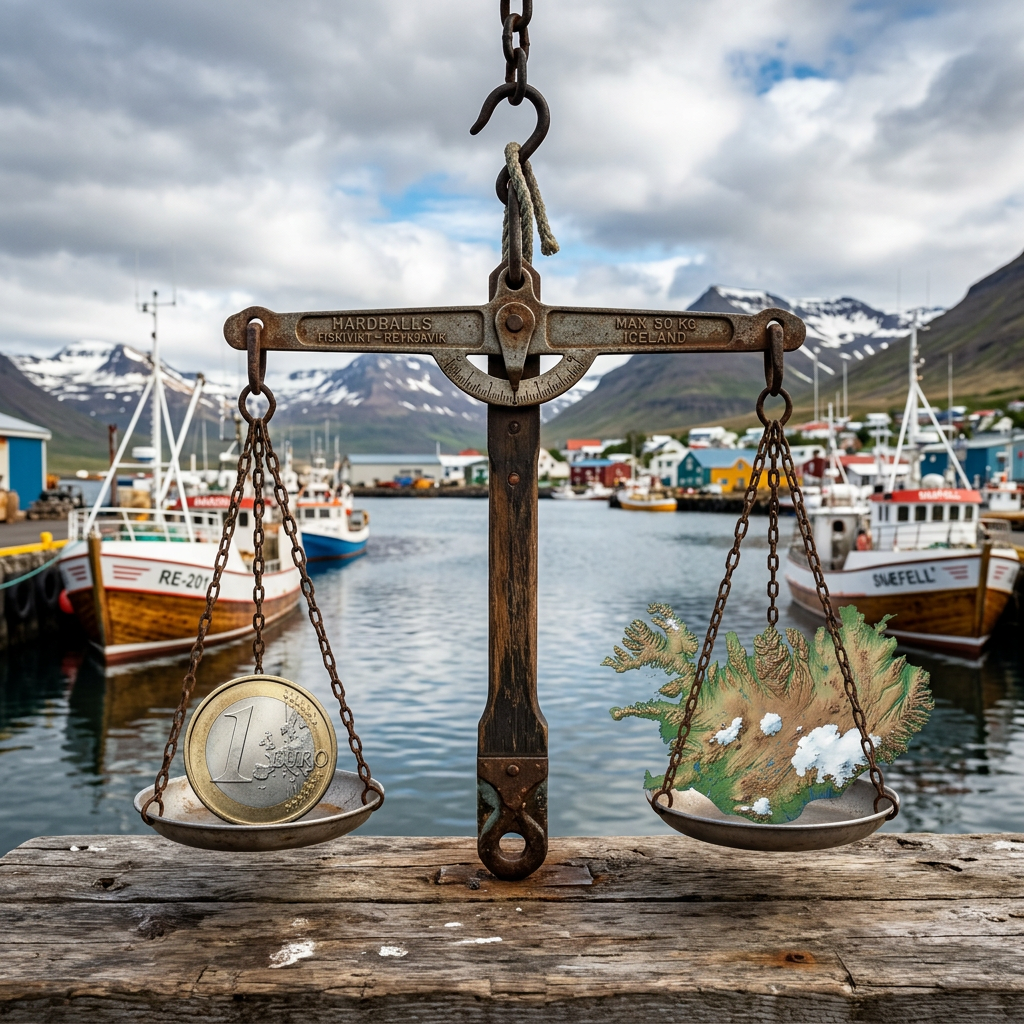
This is a piece in my series on Iceland’s referendum, and it is about the one thing every Icelander understands in their bones: money — how much, from whom, and who holds the pen when the bill is written. I have argued this series with data, and this piece is built on data too, most of it the government’s own. But I am not going to pretend the stakes are cold. This is about your money, your children’s money, and a bill that, once we agree to it, never stops coming.
Let me begin with a simple question the Yes campaign would rather you not ask too precisely: what would this actually cost?
The number depends on who is doing the sums — and the government picks the smallest
Here is the first thing you should notice. There is no single agreed figure for what EU membership would cost Iceland — and the range is enormous depending on who you ask.
The Prime Minister, challenged directly about a 50-billion-króna figure, said it was “not a number anywhere near” what would come out of negotiations, and put the cost “probably closer to 7 to 8 billion krónur.” Her own Foreign Ministry, doing the sum more fully, says the net contribution would be 10 to 15 billion krónur a year, and the additional cost over what we pay now 8 to 13 billion. And independent analysts — the Taxpayers’ Association among them — say even those figures understate it, putting the net cost as high as 34 billion and the gross payment near 47 billion.
That is a spread from 7 billion to nearly 50 billion. And notice which end of it the people asking for your Yes vote reach for every single time. When the number that determines a permanent claim on the national purse can be presented as 7 billion or as 47 billion depending on how you count, and the government reliably shows you the 7, you are not being informed. You are being sold.
So let me do the honest thing and show you both ends, and explain the difference — because the difference is the whole game.
Gross and net: you do not get to spend the “net”
Every EU member pays into the Union’s budget roughly 1% of its national income — the figure runs between about 0.9 and 1.3%. Iceland’s gross national income was just under 5,000 billion krónur in 2025. Do that arithmetic and Iceland’s gross payment to Brussels — the actual cheque the Treasury writes, the money that physically leaves the country — would be on the order of 47 to 52 billion krónur every year.
That is the number the Yes side buries, and they bury it behind the word “net.” The net figure — 10 to 15 billion by the government’s own account — is what’s left after you subtract money that comes back to Iceland in grants. And it is a real distinction; some money genuinely does return, mostly through research and education programmes. I will not pretend the gross is the whole story.
But here is what they do not say: you do not get to spend the net. The state writes the cheque for the gross — the full fifty billion — and it leaves. Some fraction returns later, on Brussels’ schedule and Brussels’ priorities, directed to the projects Brussels approves, not the ones Icelanders would choose. You send fifty and hope to see back fifteen, and you are told to think only about the difference. No household, no business, no honest budget works that way.
And even the number they want you to look at — the “small” net figure — is 10 to 15 billion krónur a year. Which brings us to the question no poster answers.
Where does it come from? There is no fourth option
Iceland is not sitting on a surplus waiting to be spent. In 2025 the government ran a deficit of 137 billion krónur. We already spend more than we take in.
So a new, permanent bill — whether it is the 10 to 15 billion the government admits to or the larger gross that actually leaves the country — does not come out of a magic drawer. It is not the government’s money. It is yours, taken from your wages and your purchases. And it can come from exactly three places, because there is no fourth:
Higher taxes. Or cuts to something you depend on — a hospital ward, a school, a road, a place in a care home. Or more borrowing, which is simply a tax on your children with the due date moved into their lifetimes.
That is the entire menu. Every króna sent to Brussels is a króna not spent on a nurse in Akureyri or a teacher in Ísafjörður — and it is sent every year, in good seasons and bad. Worse: because the contribution is tied to our national income, it grows when our economy does well. We would pay the most in precisely the years we could do the most for ourselves at home.
“But we get money back” — no, not us
Here is the rebuttal the Yes side will reach for, and here is why it fails for Iceland specifically.
They will say: other countries get money back from Brussels — the roads, the farm payments, the development funds. True. But look at who gets that money, because it is written into the rules. The EU’s big funds that actually pay a country back — the Cohesion Fund, the structural funds — are reserved, by regulation, for the poorer members: below 90% of the EU’s average income for one, below 75% for the other. They exist to lift up the less wealthy: Poland, Romania, the Baltics.
Iceland is one of the richest countries in Europe. We would qualify for almost none of it. In fact the rules go further: members as wealthy as we are — Denmark, the Netherlands, Sweden, Luxembourg — sit under a cap that limits what they can receive, precisely because they are rich. Iceland would join that club on day one: the payers, not the receivers.
So understand what membership means fiscally for a country like ours. A poor country joins the EU and is lifted — it receives more than it pays, and the money builds its roads and its institutions. A rich country joins and does the lifting — it pays in far more than it gets back, and its money builds someone else’s roads. Those are worthy things; European solidarity is a real and decent idea. But it would be Icelandic taxpayers funding the convergence of Central and Eastern Europe, permanently, with little flowing home. For Iceland, EU membership is not an investment that pays back. By the design of the system, it is a donation that never ends.
We have been asked to shoulder an external bill before
Icelanders know, better than most nations, what it is to be handed a large bill from outside and told to pay it.
In 2008, when the banks fell, Britain and the Netherlands paid out their Icesave depositors and then turned to us — a nation of some 380,000 people — and demanded around €3.8 billion, roughly €12,000 for every man, woman, and child in the country. Our own parliament was prepared to sign. And the nation said no. Not once but twice, in two referendums, in 2010 and 2011. We said no because we would not accept a vast external burden that was not ours to bear, loaded onto our children for a private failure we did not cause.
I want to be scrupulously honest about the difference, because you deserve it and because the comparison only works if it is fair. Icesave was a contested debt, arising from a private bank’s collapse, forced on us from outside, and we would have received nothing in return. The EU contribution is different in kind: it is a membership fee, entered into willingly, and in exchange Iceland receives real things — market access, programmes, a small seat at a large table. They are not the same, and I will not insult you by pretending they are.
But feel the single thread that runs through both, because it should stop you cold. Both are large external claims on Icelandic money, and both were put to the nation in a vote. And here is the difference that ought to weigh heaviest: Icesave, had we accepted it, would have ended. The calculations ran to about 2024, and then it would have been over — a finite debt, paid off, done. The bill Brussels would send has no end. It comes next year, and the year after, and in every year that your children and their children are alive. Icesave was a debt with a final payment. This is a standing order with none.
In 2008 we were forced to the edge of that cliff, and we stepped back. On 29 August, no one is forcing us. We are being invited to walk over it ourselves — and to call it progress.
What is already ours
There is a reason it hurts more to lose something you hold than to miss out on something you never had. What you hold is yours. You have already paid for it, lived inside it, made it part of who you are.
Iceland already owns most of what this deal claims to offer. We already have access to Europe’s market, through the EEA, at a fraction of membership’s cost. We already have our security, through NATO and our own defence agreements, older and firmer than any promise Brussels can make. We already have our own currency — the one that bent and absorbed the blow in 2008, and let our economy recover faster than the euro countries that could not devalue. We already have full control of our own fishing waters, the foundation the modern Icelandic state was built upon.
All of it is ours already. The referendum does not offer to give us these things. It asks us to pay — a large sum, permanently, forever after — for a lesser version of what we already possess free and clear, and to hand the pen over the currency and the fishery to people who will never love this country the way you do. No one in Brussels wakes in the morning thinking about Iceland. You do. Your neighbours do. That is not a small thing. In the end it is the whole thing.
The choice that cannot be taken back
Most decisions can be undone. You can repeal a law, reverse a policy, vote out a government and try again. This one is different. You do not un-adopt a currency. You do not reclaim a fishery once it has passed into the Common Fisheries Policy. You do not get your central bank back once it has been dissolved. Past a certain point on the road to membership, the door only opens one way.
So this is not, in the end, a vote about Europe, or trade, or even about money — though the money is real, and large, and yours. It is a vote about whether a small, proud nation that has come through every century by keeping the pen in its own hand will now sign that pen away — for a discount it does not need, a bill that never ends, and promises made by people who will not be here to keep them.
We have kept our own pen for eleven hundred years. We kept it when we were poor. We took it back when we were occupied. We held onto it in 2008, when we were nearly bankrupted and could have made the pain stop by signing away our children’s future — and we refused.
I am not willing to sign it away now, for a membership fee dressed up as a gift. On 29 August, I am voting No — and keeping what is already ours.
Sources and notes
- The range of cost estimates. The Prime Minister, challenged on a ~ISK 50 billion figure, called it far above what negotiations would yield and estimated the cost “closer to 7–8 billion krónur” (Vísir, August 2026). The Ministry for Foreign Affairs estimates the net annual contribution at ISK 10–15 billion (€70–105 million) and the additional cost over the current EEA arrangement at ISK 8–13 billion (€56–91 million), based on Finland’s net contribution of 0.2–0.3% of GDP (Vísir; Ministry memorandum to the Althingi foreign affairs committee). The Taxpayers’ Association (Samtök skattgreiðenda) estimates a gross annual payment of ISK 43–53 billion (median ~47bn) and a net cost of ISK 23–44 billion (median ~34bn) (Samtök skattgreiðenda; heimssyn.blog.is, August 2026). The June 2026 government estimate of only ISK 2–7 billion additional was based on deducting ~ISK 8 billion in existing EEA costs, of which ~ISK 5.6–6 billion is EU-programme participation (Horizon, Erasmus) that substantially returns to Iceland.
- Gross contribution arithmetic. EU members contribute roughly 1% of GNI (range ~0.9–1.3%). Iceland’s GNI was ISK 4,944 billion in 2025, projected ~ISK 5,294 billion in 2026 (Statistics Iceland; Central Bank projection). At
1%, the gross contribution is on the order of ISK 47–52 billion per year (€330–360 million). - Net contributor / cohesion eligibility. The Cohesion Fund is reserved for member states with GNI per capita below 90% of the EU average; structural/cohesion funds direct the majority of resources to regions below 75% of the EU average GDP per capita. Member states with GNI per capita at or above 120% of the EU average face a cap on receipts (currently Belgium, Sweden, the Netherlands, Austria, Denmark, Luxembourg). Iceland’s income per capita is among the highest in Europe, well above these thresholds, so it would qualify for little cohesion or structural funding and would be a net contributor. (European Commission; European Parliament Fact Sheets; European Court of Auditors.)
- Iceland’s fiscal position. General government revenue in 2025 was ISK 2,093 billion (42.2% of GDP); the general government ran a deficit of ISK 137 billion (2.8% of GDP) in 2025, after a ISK 161 billion deficit (3.5%) in 2024. (Statistics Iceland, March 2026.)
- The EU budget mechanism. Contributions are based principally on Gross National Income, set by treaty formula rather than annual national choice, and scale with GNI. Costs may rise from 2028 with NextGenerationEU repayment obligations. (European Commission.)
- Seafood tariffs (a genuine offsetting benefit). Iceland currently pays over ISK 1.4 billion a year in tariffs on seafood exports to the EU, which would end with membership (jaedanei.is, drawing on official figures). This is a real benefit and is noted for balance.
- Icesave. UK and Dutch claims following the 2008 collapse of Landsbanki’s Icesave accounts totalled approximately €3.8–3.9 billion, about €12,000 per capita. Careful estimates (CEPR/Bruegel) put the net-present-value burden near 14% of GDP, with an annual payment burden under 1% of GDP had the deal been accepted, running to about 2024; alarmist estimates reached 50%. Icelandic voters rejected repayment agreements in two referendums — March 2010 (~98% against) and April 2011 (~58–60% against). The Icesave liability was a contested obligation from a private bank failure and is not morally equivalent to a membership fee paid for benefits received; the comparison here concerns scale, permanence, and the national decision to refuse a large external obligation. (CEPR; Bruegel; LSE EUROPP; contemporary reporting.)
- 2008 currency adjustment. The króna’s ~50% depreciation helped swing Iceland’s current account from roughly −25% of GDP to balance by 2010, a faster external adjustment than euro-periphery countries achieved through internal devaluation. (Ministry of Finance “Currency Matters” report, May 2026.)
- Caveat. All contribution figures are estimates that depend on assumptions about receipts, the Finnish-model comparison, and future EU budget frameworks; they are disputed among the government, its ministry, and independent analysts, and would only be fixed through actual negotiation. Figures should be checked against the latest Statistics Iceland, Ministry, and Eurostat data at the time of reading.
Discover more from Startup Iceland
Subscribe to get the latest posts sent to your email.
