
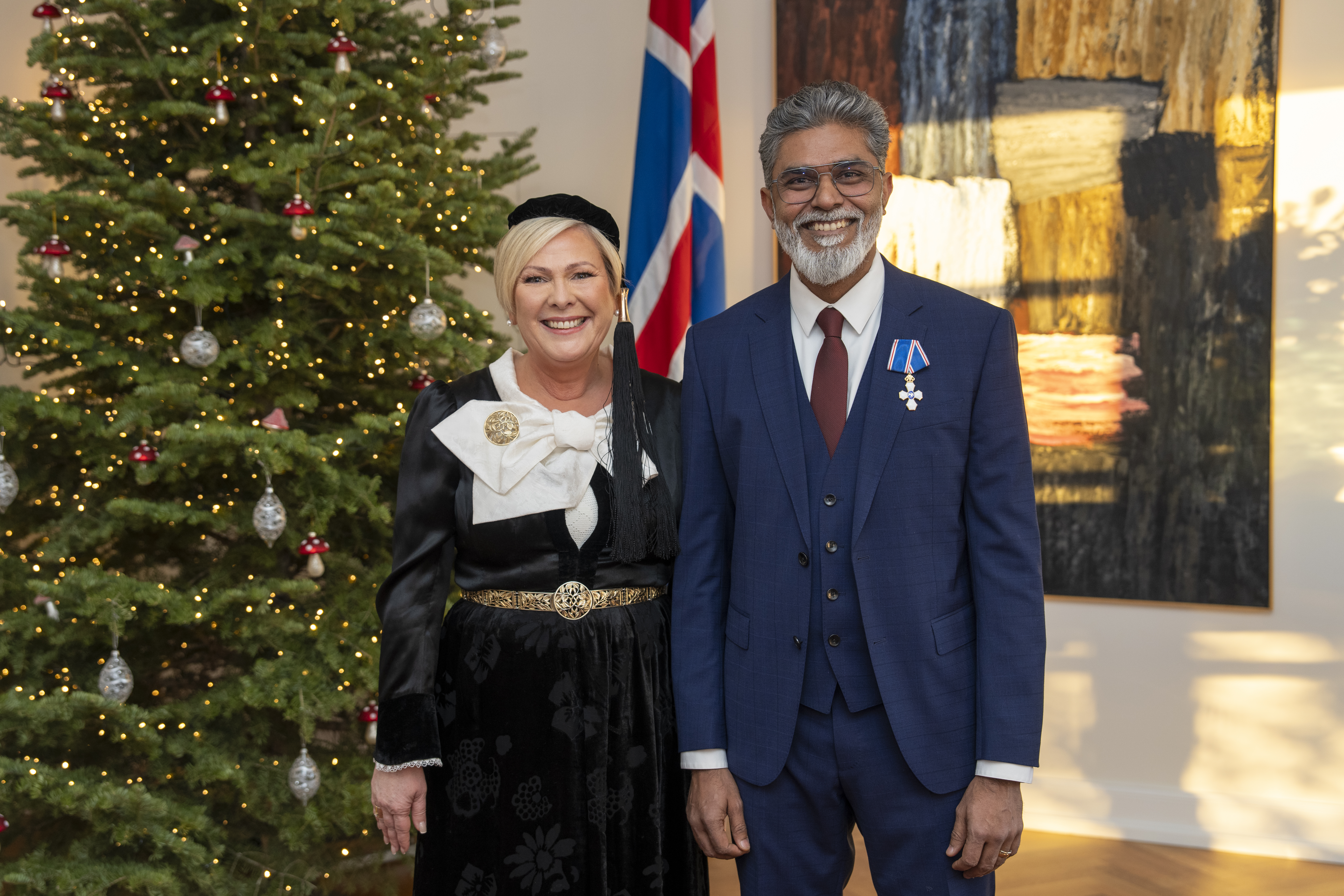
A reflection on lineage, belonging, and the strange arithmetic by which a man can come to belong to two countries at once — and be enlarged, rather than divided, by it.
There is a saying in India, offered usually with a knowing smile: you can take the man out of India, but you cannot take India out of the man. It is meant as reassurance — that whatever distance you travel, whatever passport you carry, some essential thing stays fixed in you, sealed at birth, carried unchanged to the end. For most of my life I believed it, in the way one believes things that have never been tested.
I have now lived away from India for almost thirty years, the last stretch of them in Iceland, whose citizen I am. And I have found the saying to be true, and also not true, in a way it never prepared me for. India did not leave me. But neither did it stay unchanged, sitting untouched inside me like a stone in a pocket. It did something the saying does not allow for. It made room.
I want to try to describe what made the room — because it was not an idea, and it was not a place. It was a handful of people, most of them barely old enough to rent a car, in a country the world had just finished writing off.
The twinkle
It was 2009. Iceland was, by every external account, finished. The banks had collapsed the autumn before, the currency was in ruins, the international press was writing the country’s obituary in the past tense. If you had read only the news, you would have concluded that this was a nation to leave, not to invest in.
I met the founding team of a company called Clara — Gunnar, Jón Edvald, Gummi, Haukur, Brian. They were all under twenty-four. And they believed, with a calm that I could not immediately account for, that they were going to build a company with customers all over the world. Not hoped. Not dreamed. Believed, in the flat, untroubled way you might state the time of day.
I had come to Iceland already sure of myself. I had backed myself my whole life; I knew what I was capable of. But my confidence was of a particular kind — the striving kind, the kind you build by proving yourself again and again, the kind that has to be fed. What I saw in those young founders was a different species of the thing entirely. It was quiet. It did not need an audience or a win to sustain it. It was not arrogance — I want to be precise about that, because arrogance is loud and this was the opposite of loud. It was a settled, almost matter-of-fact assumption that whatever problem stood in front of them could be solved, and that they were the ones who would solve it.
I asked Gunnar once whether it bothered him — the news, the collapse, the things the world was saying about his country and by extension about the sanity of trying to build anything in it. He answered quietly that he did not read the news. If something mattered, he said, he would hear it from his friends, through social media.
I have thought about that small answer for fifteen years.
What the answer taught me
At the time I heard it as composure, and it was. But underneath the composure was something larger that I only understood slowly. This young man was not ignoring the world. He was reading a different one. The gatekept, top-down world of newspapers and official narratives — the world telling Iceland it was finished — was not the world he lived in. He lived in a networked one, horizontal, built of communities and peers, where information moved through trust rather than through authority. He had already, instinctively, migrated to the future.
That was the moment I understood how the world was actually changing — not from a report or a trend piece, but from a twenty-three-year-old in a nearly bankrupt country telling me, without any sense that he was saying anything remarkable, that he simply didn’t read the news. I saw then that digital communities and social networks were going to remake how the world understood itself, and — more importantly — that the people who genuinely understood the technology beneath those tools would build things of enormous value for millions of people. The children of the crash were not the victims of the old world’s collapse. They were the natives of the one replacing it.
And here is the part that changed me, and not just my thesis about markets. Being among them, I caught something. The quiet confidence transmitted. I had arrived believing confidence was a thing you earned by striving; they showed me it could also be a thing you simply inhabited, a way of standing in front of a hard problem without flinching, whether or not the world was applauding. Iceland, through these people, opened a dimension inside me I had not known was there. I had always backed myself. Iceland taught me to do it quietly, without needing the noise.
Why I love the place
People sometimes ask why an Indian, thirty years gone, thinks of Icelanders as his tribe. It is not the landscape, though the landscape is a kind of scripture. It is this: Icelanders have an uncanny ability to rise precisely when everyone has decided they are lost. I did not read that in a history book. I lived it, standing next to founders who were building global companies out of the wreckage while the obituaries were still being printed. There is a spiritual stubbornness in this small nation, a refusal to accept the verdict of circumstance, that I find genuinely beautiful — and that I have tried, in the years since, to earn a place inside of.
The friends and partners I have made here are the reason I belong. Belonging is not a document or a length of residence. It is the moment other people begin to include you in their we — and mean it. That happened to me here, slowly, through work and weather and shared risk, and it is among the great fortunes of my life.
The arithmetic of two homes
So how does a person reconcile roots — India by birth, Iceland by choice? For a long time I assumed the word for it was reconcile, as if the two were accounts to be balanced, loyalties to be divided, a heart to be split down the middle so each home could have its half.
I no longer think that is what happens. I think roots do not divide. They compound.
Loving Iceland did not cost me India. It taught me things — that quiet confidence, that networked way of seeing, that stubbornness in the face of a bad verdict — which I then carried back toward India, in all the years I have spent trying to bring the two countries closer to each other. The bridge runs both ways. What Iceland put into me flows toward India; what India made me brings something India-shaped to Iceland. I am not half of each. I am, if the graft has taken, more than I would have been rooted in only one.
That is the truer image, I think. Not two loyalties in tension, but a graft. In the orchard, a graft is when you join the living tissue of one plant onto the rootstock of another. If it takes, they do not remain two things politely sharing a trunk. They become one tree — one that often grows stronger than either parent, and bears fruit neither could have borne alone. The rootstock does not vanish; it feeds everything. But the tree that grows is new.
India is my rootstock. It feeds everything I am, and it always will — the saying is right about that much. But Iceland was a graft that took, in soil I did not expect, among people I did not yet know would become my own. And the tree that grew from the two of them is not Indian, and not Icelandic, and is wholly both. I did not have to choose. That was the thing no one told me, the thing the old saying could not hold: you are not a sealed vessel carrying a fixed essence to the grave. You are a living thing. In the right soil, among the right people, you can still be added to — even in the middle of your life, even far from where you began.
The world is morphing into something new. We travel, we settle, we make homes of places our grandparents could not have found on a map, and more and more of us carry more than one country in us. I do not think the task is to reconcile them, to referee some contest between where we came from and where we landed. I think the task is to let them graft — to love the particular soil of each, to drink from both taproots, and to become the fuller tree that only someone planted twice can grow into.
You can take the man out of India. You cannot take India out of the man. Both true. And still — a small, cold, unbreakable country reached into that man and opened a room he did not know he had, and filled it with a quiet confidence and a handful of friends he now calls his own.
For that I will be grateful to the end of my roots — all of them.
Discover more from Startup Iceland
Subscribe to get the latest posts sent to your email.
