
What the PISA Decline Is Really Telling Us
Every Nordic country’s PISA scores fell in 2025. Iceland fell hardest — the steepest ten-year decline of any country measured, with 44% of our teenagers now below basic reading proficiency. The explanations arriving in the press are the ones you’d expect: phones, COVID learning loss, teacher shortages, screen time. I don’t dispute any of them. But I think we’re diagnosing the symptom and missing the disease.
I’ve spent seventeen years building a startup ecosystem in Iceland, and I’ve taught long enough at Reykjavik University to watch the same pattern repeat across very different domains. The students who go furthest. The founders who push through the year nobody would have blamed them for quitting. The athletes who break through a ceiling. Almost none of them did it on self-belief alone. Someone believed in them first. The self-belief came second — as a consequence, not a cause.
I want to make the case that this isn’t sentiment. It’s mechanism, and it’s measurable.
It isn’t a shortage of time. It’s a shortage of attention.
The easy story is that today’s parents and teachers are too busy and too distracted to show up. That’s only half right, and the wrong half matters. Time-diary data going back to the 1960s shows parents today spend more raw hours with their children than any generation on record — fathers’ direct childcare time in the US rose roughly 150% between 1965 and 2000. We have not withdrawn our physical presence.
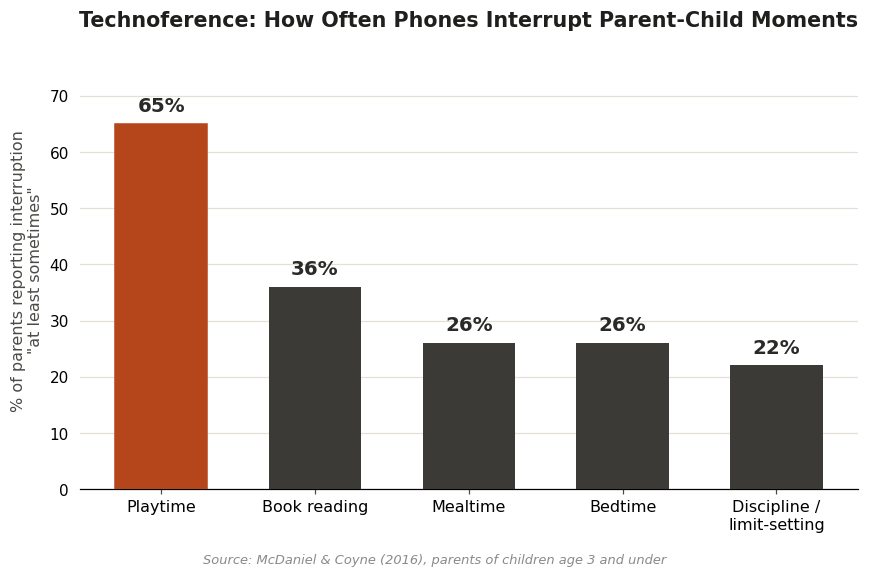
What we’ve done is fill that presence with distraction. Researchers call it “technoference” — the moment a parent’s attention snaps from the child to the phone mid-interaction. Two-thirds of parents admit to feeling distracted by their phone while spending time with their kids, and the studies confirm what we already suspect: the quality of the exchange collapses in that moment. Less responsiveness. Less of the real back-and-forth a child’s mind is built on.


(This particular dataset is drawn from parents of very young children — the pattern is best documented in early childhood, and I’m extending it by inference to the teenage years PISA actually measures.)
We didn’t leave the room. We just stopped being fully in it.
We let go of the wheel exactly when the stakes rise
There’s a second pattern layered on top, specific to the age group PISA actually measures — teenagers, not toddlers. Decades of research on parental involvement show something close to universal: as children move into adolescence, adults systematically pull back. Less homework help. Less presence at school. Precisely as the academic and life stakes are climbing fastest.
We tell ourselves this is respecting their independence. I think, more honestly, we’ve convinced ourselves of something more comfortable: they’re old enough now, they have a device that can answer anything, they’ll figure it out. That belief is where I think we’ve gone wrong — and it’s the belief this piece is written to challenge.
What presence is actually for
I don’t think “distracted” and “failing to instill belief” are two separate problems. I think they’re the same problem, seen from two angles, and I want to be explicit about the connection rather than leave it implied.
Instilling belief in a child was never a single conversation, or a speech delivered once. It happens in the accumulation of small moments — specifically, the moment right after a child gets something wrong, or right before they attempt something hard. An adult who is actually present in that moment can do two things at once: hold the child to a real standard, and respond to the mistake in a way that keeps them trying instead of shutting down. An adult who is scrolling through that same moment can do neither — not because they don’t love the child, but because both of those jobs have to happen inside the window of the struggle itself, and if you weren’t paying attention when the window opened, it’s already closed.
This matches a well-documented finding in developmental psychology almost exactly. Diana Baumrind’s decades of research on parenting style found that children do best — academically, socially, emotionally — not from strict standards alone and not from warmth alone, but from adults who deliver both together: real accountability, held consistently, combined with genuine encouragement and responsiveness. Researchers call this the authoritative style, and it outperforms both the accountability-without-warmth style (authoritarian) and the warmth-without-accountability style (permissive) on nearly every outcome measured. The same framework, applied to schools, holds up the same way — students do best under teachers and school climates that combine high standards with high support. Neither half works alone, and a distracted adult can’t reliably deliver either half, because both depend on having actually seen what just happened.
Carol Dweck’s research narrows in on the exact moment that matters most: the mistake itself, and what an adult does with it. In one long-running study, the specific way mothers responded to their one-, two-, and three-year-olds predicted whether those children showed a growth mindset five years later, in second grade — and it went on to predict their actual math and reading scores two years after that. But the response that worked wasn’t simply being nice about failure. Dweck is explicit that telling a child “good try” regardless of outcome doesn’t help, and can quietly do harm — it teaches a child the adult isn’t being honest about where they actually stand. What worked was encouragement tied to strategy and effort, delivered honestly, in the moment right after a real mistake — telling a child not that the mistake didn’t matter, but that it was exactly the mechanism by which they were about to get better. That is a far harder thing to do half-present than fully present. It requires having actually watched the mistake happen.
This is the piece I most want to land: when we are not there, in the specific sense of watching closely enough to catch the moment of struggle, we cannot do either of these jobs. We cannot hold a child accountable to something we didn’t see them fall short of. We cannot encourage them through a mistake we didn’t witness. The belief we were supposed to be building gets skipped, not because we stopped caring, but because we were in the room without being in the moment.
Self-belief doesn’t start inside us. It starts as a gift from someone else.
Here is where the psychology gets specific enough to be useful, not just poetic — and where the accountability-plus-encouragement mechanism above turns out to have a name in a different literature entirely.
Albert Bandura’s work on self-efficacy identified four ways a person comes to believe they’re capable of something. The strongest, by far, is mastery — actually succeeding at something with your own hands. But the third source, what Bandura called verbal persuasion, is a mentor’s simple act of telling you, credibly, that you can do this. On its own, it’s the weakest of the four — belief without a real chance to prove it fades fast. Paired with an opportunity to actually attempt and succeed at the thing you’re being told you can do, it becomes the spark that gets someone to attempt the mastery experience in the first place.
That, I’d argue, is precisely what a real teacher or coach does that a search engine cannot. They don’t just answer your question. They put you in front of the right challenge, and they stand there believing you’ll clear it.
This is close to the mechanism behind what psychologists call the Pygmalion effect. In the original study, researchers told elementary school teachers — falsely — that certain randomly chosen children were about to have a breakthrough year. Those children’s scores rose measurably more than their classmates’, for no reason except that a teacher believed something about them and, without necessarily realizing it, gave them more warmth, more challenge, more patient correction after failure. The original study has been challenged on its methods, and I want to be honest about that rather than borrow more certainty than the science affords — but the underlying mechanism has since been replicated at real, if more modest, strength across management, medicine, the military, and sports coaching. Expectation isn’t just a feeling projected outward. It’s a set of behaviors a person on the receiving end absorbs, and eventually grows into.
This is exactly what the Bhagavad Gita is built around, if you strip away the battlefield setting. Krishna doesn’t hand Arjuna an answer to memorize. He stands beside a man paralyzed by his own self-doubt and, verse by verse, makes him capable of an action he did not believe he could take. That is the guru-shishya relationship at its root — not information transfer, belief transfer. We reduced that to a modern instrument and a control group, but we didn’t invent the idea. We rediscovered it.
What actually buffers a child through adolescence
The research on mentoring backs this up in its own quieter way. Study after study finds mentored teenagers don’t so much surge ahead as simply not fall — while their unmentored peers drift down through the exact years I’ve described above. The most consistent finding in this literature isn’t a bonus on top of a stable baseline. It’s an interruption of a decline that happens by default. And the effect is stronger, not weaker, the deeper and more demanding the relationship is — a mentor who genuinely challenges you, not just one who is kind to you.
The coach, not the sport
I want to correct my own instinct here, because it makes the argument sharper. It’s tempting to say sport itself builds transferable discipline. The best-designed studies — the ones that isolate the effect of playing sports from the kind of kid who chooses to play sports in the first place — mostly don’t support that. Kids who stick with athletics already tend to have more of the traits we’re crediting the sport for.
What survives that correction is the same finding as everywhere else in this piece: it was never the sport. It’s whether there’s an adult inside that sport who is genuinely invested in you. A coach who shows up every week, sets a real standard, and pushes you past what you thought was your ceiling is doing the identical work as an engaged teacher or a present parent — just wearing a whistle instead of holding a red pen. Every elite athlete, and in my own experience nearly every founder who built something that mattered, names a specific person who believed in them before the results gave anyone permission to.
There’s a scene I keep returning to, because I don’t think I’ve seen this mechanism dramatized more precisely anywhere else. In the film Coach Carter, the coach spends the entire season asking one particularly resistant player, Timo Cruz, the same question — what is your deepest fear? Cruz has no real answer, and spends most of the film fighting everything Carter asks of him. Only near the end, after tragedy strips away his defenses, does he finally answer — reciting words that are, as it happens, borrowed from a much older source than the screenplay: Marianne Williamson’s writing on our deepest fear being not inadequacy but the opposite, that we are “powerful beyond measure.” Carter never handed Cruz that realization directly. He simply kept the question open, kept holding a standard Cruz kept resisting, until Cruz finally grew into what his coach had believed about him long before he believed it himself. That is this entire piece, compressed into one scene: the coach doesn’t install belief with a lecture. He holds the space open long enough for someone to grow into it.
Where this leaves the phone in every child’s pocket
None of this is an argument against AI or the tools our children now carry. Access to answers has never been the scarce resource, and it’s more abundant now than at any point in human history. What this evidence keeps pointing back to is that answers were never the thing doing the real work.
A device can tell a child what is true. It cannot look at a struggling teenager and decide: I believe you can do more than this, and I am going to stand here until you do. That belief, delivered consistently by a present adult, is the active ingredient every line of this research keeps identifying — not the knowledge, but the relationship the knowledge was always carried by.
The Nordic decline is real, and school closures, teacher shortages, and screen time all did genuine damage. But underneath the policy conversation is an older and simpler one. We have started to believe, without quite deciding to, that presence can be automated. It cannot.
Our task as parents, teachers, coaches, and mentors was never to compete with technology. It was, and remains, to be the person who believes in someone before the evidence justifies it — because that belief, more than any other single thing we’ve measured, is what teaches a human being to believe in themselves.
Discover more from Startup Iceland
Subscribe to get the latest posts sent to your email.
