
This piece steps away from interest rates and indexation to ask a question that sits underneath the whole referendum: if joining the EU is such a modest deal for Iceland economically — and the government’s own report says the gains are modest — then why is Europe suddenly so attentive? Why the first visit by a French foreign minister in over two decades, the defence agreements, the invitations? The answer is worth understanding clearly, because it is also, on inspection, one of the better reasons to vote No.
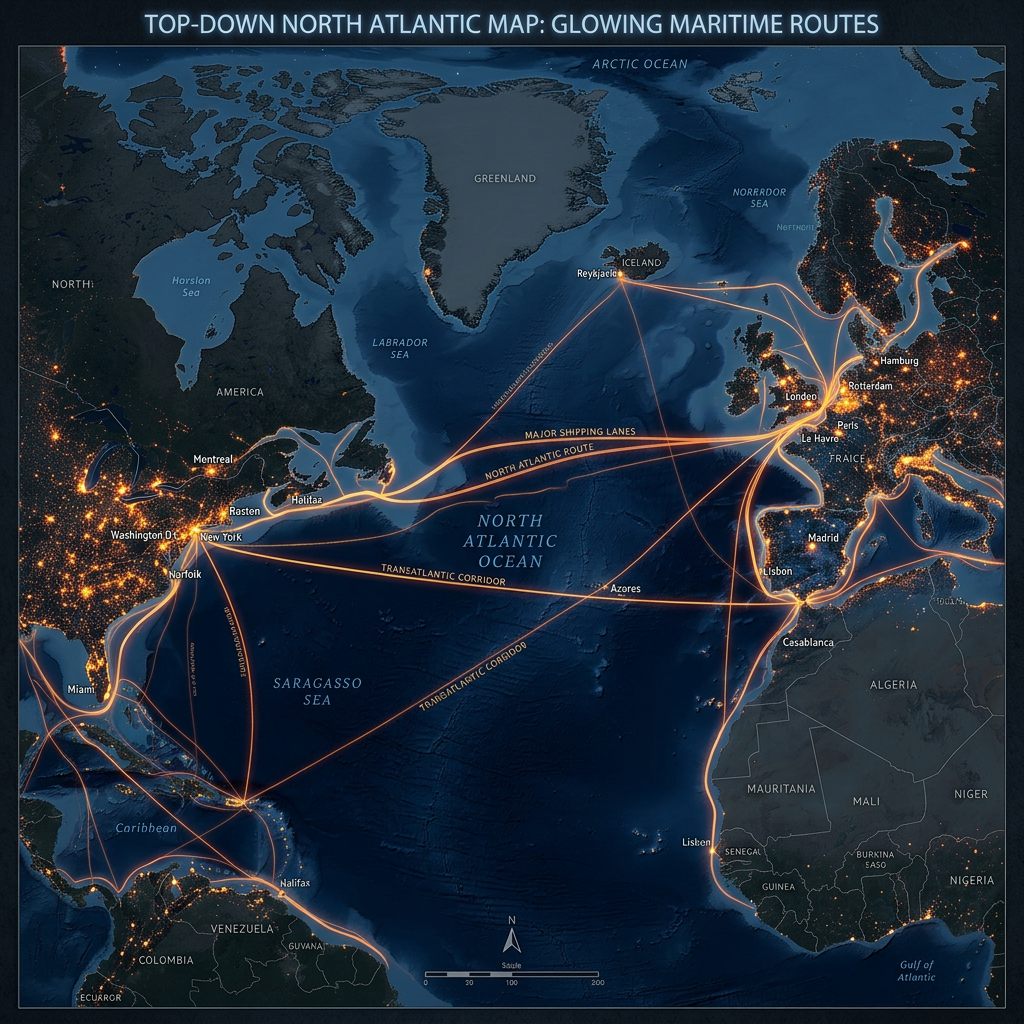
Anyone who has played the board game RISK knows a small secret about the map. Iceland is one square. It is worthless in itself — no armies to speak of, no production. But it is the only crossing between North America and Europe. Whoever holds Iceland controls whether the two continents can reach each other. Experienced players know: you do not ignore Iceland, and you do not give it away cheaply. Control the chokepoint and you shape the whole board.
The game got that right, because it was copying reality. And the reality is the key to a puzzle in the current debate.
The puzzle
Here is the puzzle. By any economic measure, Iceland is a rounding error to the European Union. Our population is about 380,000 — roughly 0.08% of the EU’s. Our entire economy is about 0.2% of the eurozone’s. If Iceland joined tomorrow, the Union’s GDP would not notice. In the European Parliament we would hold around 6 seats out of 720. In the great questions the EU decides collectively, a country our size is, arithmetically, a very small voice.
So why the sudden warmth? In July 2026, the French foreign minister came to Reykjavík — the first visit by a French foreign minister in over twenty years — and signed a roadmap on security, climate and the economy, bringing France’s largest business federation with him. In October 2025, Germany’s defence minister came, met the Prime Minister, and signed a defence agreement. Germany’s Chief of Defence had come two months before that. For a rounding error, Iceland receives a remarkable amount of high-level attention.
The puzzle dissolves the moment you stop measuring Iceland in euros and start measuring it in geography. Iceland is an economic rounding error and a strategic linchpin at the same time. The attention was never about our economy. It is about where we sit.
What Iceland actually is
Draw a line from Greenland, through Iceland, to the United Kingdom. Defence planners call it the GIUK gap, and it is one of the most important maritime chokepoints on earth. It is the gateway between the Arctic and the open Atlantic — and, crucially, it is the only route by which Russia’s Northern Fleet, based at Murmansk on the Kola Peninsula, can reach the Atlantic Ocean. Every Russian submarine that wants to threaten the shipping lanes between North America and Europe, or to sit off the American coast, has to pass through that gap.
Whoever watches the gap controls the North Atlantic. This is not new and it is not theoretical. The Allies occupied Iceland in the Second World War for precisely this reason — to keep the sea lanes open. Through the Cold War, the GIUK gap was the frontline for tracking Soviet submarines coming out of Kola. And it has returned to the centre of NATO planning now, as Russia rebuilds its Arctic bases and its submarines are believed to be mapping the undersea cables that carry the world’s data and finance. Keflavík, defence analysts now say, needs to be the epicentre of North Atlantic surveillance. NATO runs an annual anti-submarine exercise, Dynamic Mongoose, in the waters off Iceland. Seven of the eight Arctic states are NATO members.
This is what Iceland has to trade. Not markets — the chokepoint. And every serious player in the world understands its value, which is exactly why they are being so friendly.
The thing the courtship reveals
Now watch closely, because the courtship contains its own answer to the referendum.
Look at how Europe is actually accessing Iceland’s strategic value right now. In October 2025, Germany signed a bilateral defence agreement with Iceland that lets German frigates, submarines, and maritime patrol aircraft operate out of Icelandic ports and Keflavík. That is real, substantial military cooperation — a forward NATO presence on the most important chokepoint in the Atlantic. And it required no EU membership. No euro. No surrender of the fishery. It was a bilateral agreement between two sovereign allies, signed and done.
The French visit was the same shape: a roadmap on security and defence cooperation, signed between two governments, requiring nothing more than that both wanted it. Britain and Norway signed their own GIUK pact in December 2025. The entire machinery of North Atlantic security is being built and deepened around Iceland right now — through alliances and bilateral agreements, none of which require anyone to join anything or give anything up.
That is the whole argument in one observation. If the strategic value Iceland offers can be — and is being — accessed through cooperation between sovereign states, then accession is not the price of Iceland’s security. Iceland already has its security, and is deepening it monthly, without surrendering a thing.
The security argument, answered by the facts on the ground
The strongest case for voting Yes has become the security case: the world is dangerous, America is unreliable, the Arctic is contested, so Iceland must anchor itself in Europe. I have taken this seriously throughout, because the underlying facts are real. But look at what Iceland already holds, and the argument comes apart in your hands.
Iceland has been a founding member of NATO since 1949. It has had a defence relationship with the United States since 1951. It sits under NATO’s Article 5 — the collective-defence guarantee that an attack on one is an attack on all — which is the single most powerful security guarantee on the planet, and Iceland has it already. On top of that bedrock, Iceland has just signed fresh bilateral defence agreements with Germany and France, and sits inside a thickening web of North Atlantic security cooperation with Britain, Norway, and the United States.
There is nothing the European Union adds to this that Iceland does not already have. The EU is not a defence alliance; NATO is, and Iceland is in it. The specific security cooperation the Yes case invokes — surveillance, submarine tracking, Arctic presence, resilience — is being delivered through NATO and bilateral agreements, on Icelandic terms, today. Accession would add a currency union and a fisheries surrender to a security position that is already complete. You do not need to sell the house to keep the alarm on.
The asymmetry
Set the two sides of the trade next to each other and the shape of it becomes clear.
What Europe wants from Iceland is the chokepoint — a strategic asset that is permanent, geographic, and genuinely valuable to the whole Western alliance. What Iceland is being told it will receive in exchange is a modest economic benefit: the government’s own report puts the cost-of-capital gain from the euro at somewhere between a quarter and one percentage point, and pairs it with real risks. And a seat — a 0.08% voice — at a table that would then decide, collectively, matters Iceland now decides alone. What Iceland would give up to get it is its currency, permanently and irreversibly; control over its own fishing waters, which France has again just declined to guarantee; and full national authority over the domains the Union decides in common.
That is an asymmetric trade. Iceland would surrender permanent, sovereign assets to obtain a modest and largely home-achievable economic benefit — while the strategic value it is actually being courted for is something it can already lease, again and again, through alliances it controls, without giving up anything at all.
This is not a claim that Europe is acting in bad faith. It is not. Every country pursues its interests, and the EU’s interest in a friendly Iceland inside its structures is rational and legitimate. The point is simpler and colder than any accusation: Europe’s interest in Iceland and Iceland’s interest in Europe are not the same interest. Europe wants the location. Iceland wants a cheaper economy. The location is permanent and valuable and flows outward; the cheaper economy is modest, uncertain, and largely available at home. When the thing you are asked to give is worth far more than the thing you are offered, the friendliness of the offer is not a reason to accept it.
Hold the card
There is an old wisdom in negotiation: if you are holding something the other party badly wants, that is precisely the moment not to give it away — it is the moment it is worth the most. Iceland is holding one of the most valuable strategic cards on the North Atlantic board. The visits and the roadmaps and the defence agreements are the proof of its value, arriving in person.
A small nation that understands what it holds does not surrender it to join a currency union for a quarter-point of interest. It keeps the card, leases its use to its allies on its own terms — as it is doing, successfully, right now — and stays the author of its own affairs. Every experienced player at the table understands Iceland’s advantage. My hope is that every Icelander understands it too, before we are persuaded to trade away the very thing that makes us worth courting.
On 29 August, I am voting to keep the card.
Sources and notes
- The GIUK gap and Iceland’s strategic position. Greenland–Iceland–UK maritime chokepoint controlling Russian Northern Fleet (Murmansk/Kola) access to the North Atlantic; central to NATO anti-submarine and surveillance posture; Keflavík identified as a hub for North Atlantic surveillance; concern over Russian mapping of undersea cables; NATO’s annual “Dynamic Mongoose” anti-submarine exercise off Iceland; seven of eight Arctic states are NATO members. (Heritage Foundation, March 2026; CSIS Nuclear Network; The Arctic Institute; Geopolitical Monitor; NATO Allied Maritime Command, 2025.) The wartime Allied occupation of Iceland (1940–41) and the GIUK gap’s Cold War role are standard historical record.
- Bilateral defence cooperation without EU membership. Germany–Iceland defence agreement, October 2025, permitting German frigates, submarines, and maritime patrol aircraft to operate from Icelandic ports and Keflavík; visits by German Defence Minister Boris Pistorius (October 2025) and Chief of Defence Gen. Carsten Breuer (August 2025). UK–Norway GIUK defence pact, December 2025. Germany fielding P-8 Poseidon patrol aircraft for GIUK patrols. (Iceland Review; globalsecurity.org; Stars and Stripes; Heritage Foundation.)
- The French visit. French Foreign Minister Jean-Noël Barrot visited Iceland 20–21 July 2026 — the first visit by a French foreign minister since 2000 — signing a roadmap on security, climate and economic cooperation, accompanied by the French business federation MEDEF. Asked directly whether France could accept Iceland retaining permanent national control over its fishing waters, Barrot declined to affirm it, reframing the question around Iceland’s existing membership of the Council of Europe and the European Political Community. France’s 2010 position — no special privileges, minimal transition periods, no permanent exemptions, particularly on fisheries — was noted in coverage of the visit. (Iceland Monitor; Iceland Review; France Diplomatie press records, July 2026.)
- Scale figures. Iceland ~380,000 people (~0.08% of EU population); economy ~0.2% of eurozone GDP; ~6 seats in the 720-seat European Parliament; one Commissioner of 27. Euro cost-of-capital gain estimated at 25–100 basis points, Iceland-specific estimate ~50bp. (Ministry of Finance “Currency Matters” report, May 2026; Eurostat.)
- Iceland’s existing security guarantees. Founding member of NATO (1949); bilateral defence relationship with the United States since 1951; covered by NATO’s Article 5 collective-defence guarantee. (Standard record.)
- Caveat. This piece argues that Iceland’s strategic value is accessible through alliance and bilateral cooperation rather than EU accession; it does not dispute that the strategic environment has changed or that security cooperation with Europe is valuable — it argues that such cooperation does not require monetary or political union, as the recent bilateral agreements themselves demonstrate. Readers who weigh the security dimension differently may reasonably reach different conclusions; the facts about Iceland’s existing guarantees and the recent agreements are not in dispute.
Discover more from Startup Iceland
Subscribe to get the latest posts sent to your email.
