
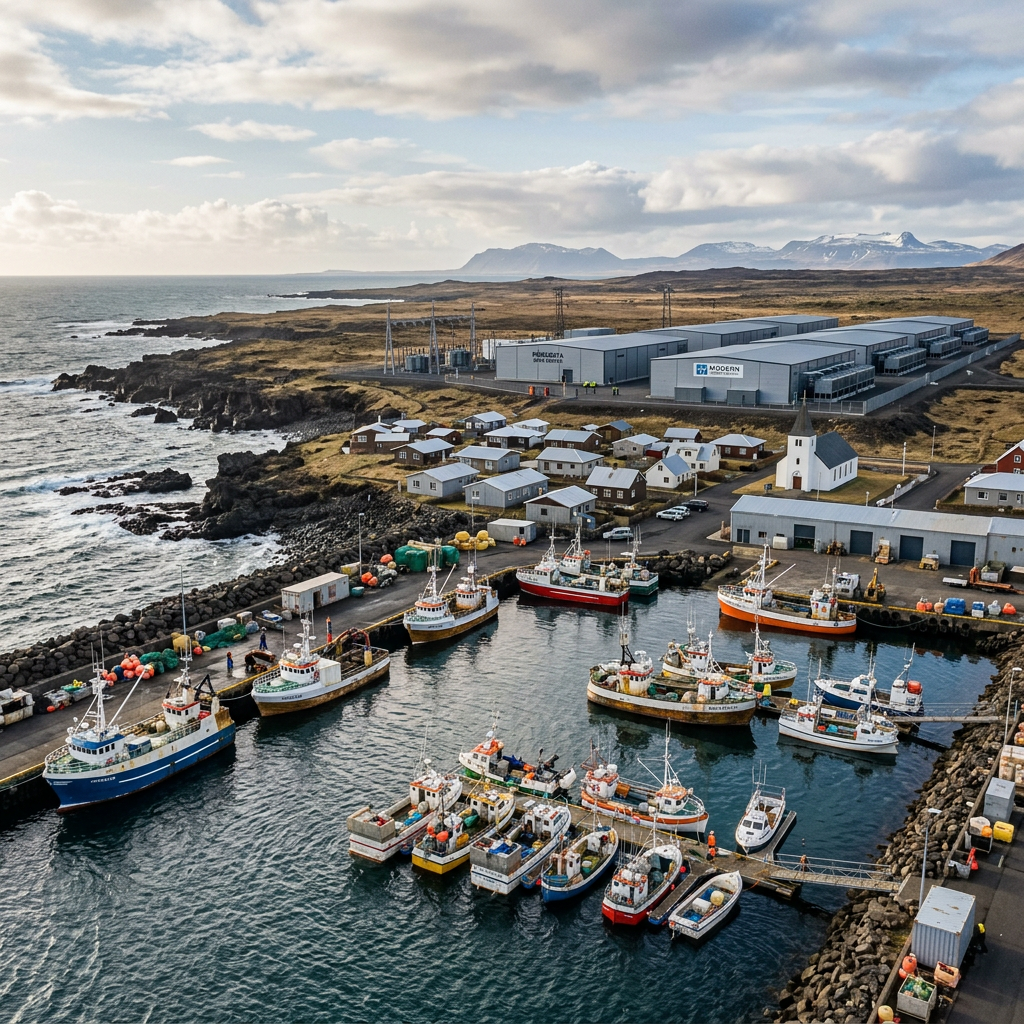
The Engine Is Ours to Rebuild: Why the Euro Won’t Fix Iceland’s Cost of Capital — and What Would
This is a companion to my earlier piece on verðtrygging, “The Painkiller That Became the Disease.” There I argued that Iceland’s indexation regime persists because it works too well for the people who hold the debt — anesthetizing the country to its own inflation. This essay widens the lens to the whole cost of capital, and to the question the indexation story raises but does not answer: if the problem is ours, made at home, why do we keep looking abroad — to the euro — for the cure?
There is a serious conversation underway in Iceland about whether to join the European Union, and the argument doing most of the work is monetary. Capital is expensive here, the reasoning goes, because we carry our own small, volatile currency. Adopt the euro and interest rates fall toward continental levels. The cost of capital that strangles Icelandic firms simply melts away.
I want to make a different argument, and a more hopeful one. The reason capital is expensive in Iceland is, in large part, something we did to ourselves — through choices written into our own laws and regulations, held in our own hands, changeable by our own institutions. That sounds like an indictment. It is the opposite. A problem you imported is a problem you must beg someone else to solve. A problem you built is a problem you can fix. The high cost of capital is not weather that happens to Iceland. It is architecture Iceland designed, and architecture can be redrawn.
This is why the euro question, for all its importance, is the wrong place to start. Reaching for the euro to solve the cost of capital is reaching for an external fix to an internal problem — and the very impulse to reach outward is the tell. It is the quiet admission that we have stopped believing we can reform ourselves. This essay is a bet that we can. It will show, as plainly as I can, where the cost of capital comes from, who holds each lever, and what the first moves are. The euro appears throughout not as the enemy but as the tempting shortcut that keeps us from the work that would actually unlock this country’s potential.
The diagnosis first, because you cannot rebuild an engine you have mistaken for a thermometer.
What a currency actually is
A currency is a claim on an economy. Its value, its volatility, and the interest rates attached to it are downstream of what the economy produces, how it saves, and how credibly it manages its institutions. The króna does not cause Iceland’s economic structure; it reports on it. It is volatile because the economy behind it is small, concentrated in a few cyclical export sectors, and exposed to terms-of-trade swings a larger economy would absorb without a ripple. Replacing the unit of account does not change what is being accounted for: adopt a stronger currency without changing the underlying allocation of capital, and you have changed the label on the bottle, not the contents.
That said — and here the purist version of my own argument overreaches — the currency regime is itself one of the fundamentals, not merely a mirror. A small floating currency carries a permanent risk premium that has little to do with productivity. Investors demand compensation for exchange-rate volatility and for the tail risk that a small open economy will, under stress, impose capital controls. Iceland did exactly that: controls imposed in November 2008 under an IMF programme were not fully lifted until March 2017 [6][7], and this was no one-off — the country has spent close to a quarter of its post-independence history in some form of currency crisis [8]. That history is priced in. So part of Iceland’s high cost of capital is a currency premium, and the euro would genuinely remove part of it.
The honest claim is therefore narrower than the slogan, and has to be stated by sector rather than as a single number: for the economy in aggregate, the currency premium is the smaller term and the domestic structural drivers are the larger one — but for the part of the economy financed by international equity, the currency premium is large, possibly the dominant term. Both are true; they point in opposite directions; and the rest of this essay tries to hold them honestly rather than collapse them into a slogan either way.
The first domestic driver: the pension floor nobody campaigns on
The largest driver of Iceland’s cost of capital is not the króna. It is the architecture of the pension system — and it has to be stated carefully, because it is easy to overclaim.
Iceland runs one of the most fully funded mandatory pension systems in the world. The mandatory contribution is 15.5% of wages — the highest such rate in the OECD [1] — participation is near-universal, and the funds hold assets of roughly 180–200% of GDP, larger than the entire banking and insurance sectors combined and more than enough to buy every listed equity, bond and bill in the country [2][3]. The funding itself is an enviable achievement; Iceland has topped the Mercer CFA Institute global index in recent years [4]. The problem is not that the funds exist. It is what their size does in a market this small.
The funds discount their liabilities at a fixed real rate of 3.5%, set by Regulation No. 391/1998 and unchanged since, with no established mechanism for adjustment [5]. This is not a soft convention. It is bound to a hard funding rule: a fund must hold its actuarial funding ratio within roughly 90–110%, and on a breach its board is legally obliged to act — in practice, to cut accrued and future pension rights [5]. A fund whose assets fail to clear 3.5% real does not merely underperform; it is pushed toward a statutory benefit cut. That is what forces the chase for 3.5% real returns.
The tempting next step — to say this one number sets the cost of capital for the whole economy — does not survive comparison. The Netherlands, Canada and Australia all run large funded systems targeting real returns, and none carry Iceland’s cost of capital. If the discount rate alone were the mechanism, they would show it. So the rate cannot be the sole cause. What makes Iceland different is the interaction of the rate with smallness and concentration. A 3.5% hurdle is harmless where pension funds are one buyer among thousands. It becomes binding when the funds holding 180–200% of GDP are the only large pool of savings in the country — and when, as the OECD has flagged, those same funds are a major source of household mortgage lending, the largest domestic equity investors, and among the largest owners of two of the three systemic banks [3]. The funds do not merely participate in the domestic capital market. They very nearly are it, and they carry a return hurdle wherever they go.
That is the defensible claim: not a single law dictating the price of capital, but a return hurdle attached to a pool so large it exhausts the domestic investable universe and sets the marginal price of capital across mortgages, equities and banks at once — because it owns or funds all three. And the whole mechanism is denominated in real terms and is currency-agnostic. Switching to the euro removes the currency premium and lowers nominal rates, but it does nothing to a real hurdle written into pension law and embedded in a savings pool that dwarfs the economy. You can join the euro and still face a domestic market whose dominant participant demands 3.5% real and has nowhere small enough to hide — while having surrendered the central bank, the exchange rate, and the capital-flow tools Iceland uses to manage the consequences.
The second domestic driver: banking concentration
If the pension system is the largest structural driver, the banking system is the second. Iceland’s market is effectively a three-bank oligopoly — Landsbankinn, Íslandsbanki, Arion — atop a population under 400,000. Three banks for that few people is not a market with vigorous price competition; it is one with comfortable, persistent margins, and Icelandic banks have for years posted returns above European peers, with S&P projecting the three at roughly 10–12% return on equity [9]. Wide spreads here are not distress. They are pricing power.
What makes it worse than an ordinary concentrated market is that it is not independent of the pension problem — it is the same capital wearing a second hat. The OECD’s observation is the telling one: the pension funds are among the largest owners of two of the three systemic banks and are themselves a major direct source of mortgage lending [3]. So the dominant pool of savings, carrying its 3.5% hurdle, both owns the banks that set lending spreads and competes alongside them as a lender. The structural floor and the banking spread are not two taxes on capital. They are the same money pricing capital expensively through two channels at once — and both are wholly domestic and currency-independent. A Reykjavík borrower under the euro would pay the lower base rate plus the same domestic spread, from the same three banks, owned by the same funds. The currency changes; the market structure does not.
The third domestic driver: the inflation we build and measure
The third structural tax on capital is inflation — and, like the other two, most of it is built at home. The instinct is to treat inflation as something that happens to a country: oil, war, a global shock. Iceland has those too, and the climb above 5% in early 2026 was lifted by Gulf oil prices, with the policy rate back to 7.75% by mid-year [12]. But strip out the cycle and look at the floor: inflation averaged above 6% across 2020–2025 and has barely touched the 2.5% target in years [12]. That is not a spike. It is a chronic condition, and chronic conditions have structural causes. Two of the three are entirely domestic — and one is not even an economic force but a measurement choice.
The first is housing, and specifically how Iceland measured it. Until June 2024 the cost of owner-occupied housing entered the CPI through a “user cost” method tied to house prices and real rates. The IMF’s decomposition is striking: that one subcomponent, carrying about a fifth of the index’s weight, added an average 1.8 percentage points to headline inflation every year from 2001 to mid-2024, opening a persistent gap between headline and ex-housing inflation [13]. For two decades, close to two points of Iceland’s “inflation problem” was an artifact of methodology. Then, in June 2024, Iceland changed the methodology to a rental-equivalence approach — unilaterally, domestically, no treaty and no one’s permission [13]. Hold onto that fact; it is the cleanest proof in this essay that Iceland reforms its own machinery the moment it decides the machinery is wrong.
The second domestic driver is verðtrygging, the subject of the companion essay, and it is the hinge that connects inflation to the cost of capital. Indexation injects the housing CPI mechanically into the rest of the economy: around seven in ten rental contracts are CPI-linked and reset monthly [14], and indexed mortgages carry the same linkage on the debt side, so inflation perpetuates itself without anyone needing to expect it. Worse, it partly defeats the Central Bank’s main tool. When the bank raises nominal rates, households facing payment shock refinance out of non-indexed and into indexed mortgages to restore cash flow — fleeing toward the very instruments that make inflation stickier [15][16]. The bank cools house prices but not rents, and the rate hike, instead of biting, drives people into indexed debt. A central bank fighting inflation through a population that can index its way around the increase is fighting with one hand. This is not bad luck; it is design — and design Icelandic law can change.
The third driver is the one the euro would genuinely fix: the currency. A small floating króna passes import shocks straight through to domestic prices, and two decades above target have left expectations chronically de-anchored, a condition that predates COVID [15]. This is the honest euro point on inflation, and it deserves full strength because it is stronger than the euro point on the cost of capital: perhaps a third of the inflation problem is currency-rooted, and the euro would attack that third at the source. A wise euro advocate should argue inflation, not interest rates — it is their better ground. But notice the arithmetic, which is the arithmetic of the whole essay: the two largest chronic drivers — the housing methodology and verðtrygging — are wholly domestic and within Iceland’s own legislative reach. One is already fixed. The other is a creature of Icelandic law, abolishable by the same. The euro helps with the currency third; the structural two-thirds are ours.
Inflation, the pension floor, and banking concentration are not three separate stories. They are three faces of one domestically built cost structure — and chronic above-target inflation raises the inflation risk premium baked into every nominal Icelandic rate, which is how this driver feeds directly back into the price of capital.
The economy underneath, and where the euro genuinely helps
To weigh accession honestly you have to see that Iceland’s pillars respond very differently to monetary integration.
Fishing is the foundation: quota-managed, export-oriented, priced in foreign currency, and a natural beneficiary of a flexible exchange rate that lets the sector absorb shocks through the currency rather than through wages and jobs. It is also where the Common Fisheries Policy collides most directly with sovereignty over Icelandic waters — historically the hardest obstacle to accession. Tourism is the volatility engine, intensely exchange-rate sensitive on both sides; the euro would steady the unit it is priced in, gaining predictability at the cost of the competitiveness a weak króna confers. Power — cheap, renewable geothermal and hydro — is Iceland’s most durable advantage and is almost untouched by the currency question; what matters there is energy policy and grid access, not whether contracts settle in króna or euro.
And then the knowledge economy — software, biotech, deep tech, AI, the blue economy — which is where the euro’s advocates make their best case, and where I want to examine it most carefully, because I make my living in this seat. The conventional argument runs like this: these firms are financed not by domestic capital but by international equity — funds and LPs in London, Stockholm, Berlin, San Francisco — for whom the domestic structural floor is irrelevant but the króna is not. An international LP, the argument goes, already underwrites company, venture, and fund-manager risk, and the króna piles on a fourth, orthogonal layer of currency risk on the whole position, in a currency that imposed controls within living memory. On that view the currency premium is largest exactly where Iceland’s ambitions are highest, and the euro would help most where it matters most.
It is the strongest version of the pro-euro case. And from inside the business, it is weaker than it sounds — for two reasons the conventional argument misses.
The first is the mathematics of venture itself. Venture returns follow a power law: a fund’s outcome is dominated by its handful of exponential winners, the companies that return 10x, 50x, the whole fund. Against outcomes of that magnitude, a few percentage points of annual currency drag is not a material variable — it is rounding error swamped by the dispersion of the returns themselves. LPs who commit to venture are pricing the size and probability of the tail, not the currency the fund reports in. This is not a theoretical point. In my own experience raising and running an ISK-denominated, locally governed fund, the overwhelming majority of investors simply do not treat the currency of denomination as a factor in the decision — because they understand that if the fund works, the currency is noise, and if the fund fails, the currency was never the reason.
The second is that the “startups suffer from króna risk” claim partly has the sign backwards. An Icelandic software or biotech company sells its product globally — revenue in dollars and euros — while paying much of its cost base, salaries above all, in króna. That firm is structurally long foreign currency: a weak króna lowers its costs in hard-currency terms while its revenue holds, improving its margins. Operationally, the export-oriented startup is naturally hedged, and benefits from precisely the exchange-rate flexibility the euro would remove. The companies Iceland most wants to build are the ones least hurt — and often helped — by having their own currency.
I will concede the sliver that survives this. Currency risk does exist at one level: a foreign LP putting euros into an ISK fund and taking distributions back in euros carries translation risk on the investment, distinct from the operating company’s natural hedge. And a shrinking minority of institutional LPs run mandates that screen out unhedged exotic-currency exposure before returns ever enter the conversation — for them the króna is a gate, not a discount. That is real, and it is the honest residue of the euro’s startup case. But it is a narrow and narrowing exception. Global venture has moved decisively toward backing teams and ideas across jurisdictions and currencies; the founders who win raise from the LPs who evaluate the idea, not the denomination. The power law is why the residual currency exposure is ignorable, and the natural hedge is why the operating businesses are protected. Put together, they turn the euro’s strongest economic argument into its most overstated one.
So the honest conclusion cuts the other way from the conventional wisdom. Even for the knowledge economy — the sector the euro advocate points to first — the currency is a second-order concern next to the thing that actually determines whether Iceland builds great companies: the quality of the ideas, the founders, and the capital ecosystem around them. And that ecosystem is shaped far more by the domestic cost of capital, the depth of local markets, and the availability of non-bank financing than by whether the fund reports in króna or euro. The euro does not build the knowledge economy. Icelanders do.
The case for the euro, stated fairly
An essay this one-directional owes the other side its strongest form. The case for accession and the euro:
It removes a currency risk premium that has nothing to do with productivity, lowering nominal rates and improving access to foreign capital — most valuable to firms and households borrowing domestically in króna. It eliminates the tail risk of capital controls, priced into every long-dated Icelandic claim. It deepens integration with Iceland’s largest trading bloc and cuts exchange friction for tourism and trade. It imports external monetary discipline that Iceland has struggled to supply at home. And it steadies the planning environment for capital-intensive investment.
The case against is the mirror image. It surrenders the exchange rate — the shock absorber the fishing and tourism export base uses to adjust without mass unemployment; for an economy this concentrated and cyclical, a real loss, and the textbook optimal-currency-area objection. (In fairness, depreciation is no free lunch: it raises import prices and, because much household debt is inflation-indexed, can raise real financing costs even as it helps exporters. The absorber works for the export sector and labour market, not painlessly for the household balance sheet.) It does not touch the domestic structural floor — pensions, concentration, indexation all survive intact. It reopens the Common Fisheries Policy question over the resource that built the country. And it cedes monetary policy to an ECB calibrated for a continent whose cycle Iceland does not share — fish prices, tourist arrivals and aluminium do not move with the German business cycle.
“But the euro would force the reform”
The most serious pro-accession argument turns the whole critique on its head. Yes, a defender concedes, the domestic structure is the real problem — but Iceland has had decades to fix it and hasn’t. External discipline is exactly what breaks domestic deadlock: tie your hands to the ECB, remove the escape valve of depreciation, and reform becomes unavoidable.
It fails on a specific point. External monetary discipline forces reform only when the binding constraint is monetary indiscipline — deficits, debasement, an absent will to stop. That is not Iceland’s situation. The 3.5% floor is not weak monetary governance; it is a deliberate feature of a system that is, by world standards, exceptionally well run. Frankfurt has no lever on Icelandic pension law and cannot amend lög nr. 129/1997. So the discipline lands on the wrong target: Iceland surrenders the exchange rate — a tool it controls and uses — while applying no pressure to the discount rate, the variable that actually sets the domestic price of capital. That is the true worst of both worlds: a currency you do not control and a cost of capital you still do not control, having traded away the one instrument that lets a small, shock-prone economy adjust. The reform would remain exactly as hard as today, now attempted without a central bank, without an exchange rate, inside a union calibrated for someone else’s cycle. The discipline argument assumes the euro supplies a missing will. It removes a working tool and leaves the missing will missing.
The geopolitical dimension
There is a layer beneath the economics, and I mark it clearly as the most contestable part of this essay: it rests on a judgement about the world, not a measured quantity.
Iceland has been a founding member of NATO since 1949, yet maintains no standing army and depends entirely on allies for defense. That dependence is the central fact of Icelandic security — the country cannot defend itself alone, and pretending otherwise is fantasy. But the response to military dependence is not to compound it with monetary dependence. Precisely because Iceland must rely on others for the hardest security, it has reason to keep sovereign control of the levers it can hold — currency, capital markets, energy, resource terms. Call it not self-reliance, which Iceland cannot claim, but strategic autonomy.
The good objection is that Iceland has already integrated deeply — EEA, Schengen, the single market, NATO — so if integration corroded sovereignty, that ship sailed long ago, and joining EU institutions might increase its influence over rules it now adopts without a vote. True for most of what accession touches, which is why the EEA/Schengen comparison usually settles sovereignty arguments. But it is the wrong analogy for the monetary question, because of the difference between a peacetime rule and a crisis instrument. Schengen governs normal times, and Iceland has never had to suspend it to survive. Monetary sovereignty is exercised rarely, in extremis, and valued precisely in the crisis you did not forecast — Iceland used capital controls in 2008 to survive a shock no model had priced. That is not a peacetime rule you trade for a seat at the table; it is an emergency lever, and the euro sells it permanently. The claim, at its most defensible, is narrow: not that monetary sovereignty improves Iceland’s day-to-day position — it largely does not — but that it is a recoverable-only-once option whose value is highest in exactly the scenarios that are becoming less remote. Keeping the currency costs a measurable premium in normal times; giving it up costs an unmeasurable amount in a tail event you cannot price. A small, exposed, resource-rich state should think hard before selling tail-risk insurance to buy a discount it could have earned by reforming its own pension law.
What would actually lower the cost of capital
Diagnosis is the easy part. If the problem is structural, the remedies must be too — and they are not equal. They sort into first-order levers that drain the concentrated domestic pressure and second-order ones that help but work slowly. Ranked by how directly each attacks the mechanism:
First order. Fix the currency-hedging plumbing so the pension pool can deploy abroad. If the pool carrying a 3.5% hurdle can satisfy it in deep global markets, it stops being forced to extract 3.5% real from a domestic economy too small to produce it sustainably. But note where the constraint actually is, because a recent reform clarified it. In July 2026 the Althingi liberalized the funds’ investment authority — toward a prudent-person standard, lifting the cap on unlisted holdings — yet deliberately left the foreign-investment ceiling alone, and a senior fund manager explained why: the permitted share is already about 54.5%, rising 1.5 points a year toward 65%, while the funds actually hold only around 40% abroad, so raising the cap would have changed little [10][16]. The ceiling is slack; it was never the binding constraint. What binds is the plumbing — the machinery to hedge currency exposure back into króna runs almost entirely through the same three banks, whose forward FX positions are themselves regulation-limited [11]. So the lever is not the cap but deepening the FX-hedging market so the funds can use the headroom they already have. The honest cost: more outbound flow pressures the króna — the very stability concern the euro debate is about. This remedy trades cost-of-capital relief against exchange-rate stability, keeps that trade-off explicit, and keeps it under Icelandic control.
Revisit the actuarial reference rate. The most direct lever on the hurdle itself, and the most radioactive, because lowering the assumed real return reads — wrongly but unavoidably — as “cutting pensions.” It need not mean that; it means aligning the assumption with a return the economy can actually deliver, so funds stop being legally pushed to demand what the domestic economy cannot sustainably pay. The political cost is real, and a serious proposal must pair any change with a transparent account of what it does and does not do to benefits.
Second order. Introduce real competition into banking — lower entry and licensing barriers, enable cross-border lenders, dilute pension ownership of the banks — to narrow spreads set by an oligopoly with pricing power. Actively court foreign lenders and direct investment, lowering diligence costs through transparency and a navigable regulatory on-ramp. Deepen domestic capital markets — a broader listed market, a real corporate bond market, more diverse institutional participation — so the pension hurdle no longer propagates through a market with too few other buyers. And build non-bank financing channels for startups — venture, private credit, EIF co-investment, diaspora and strategic capital — the one area where euro adoption and domestic reform are complements rather than substitutes: cheaper foreign equity and deeper local channels would compound.
All six require joining nothing. They attack the drivers the euro cannot touch — and, as the knowledge-economy section argued, even the sector where the euro’s advocates expect the currency to matter most turns out to be shaped far more by these domestic levers than by the denomination of the fund. Non-bank startup finance, deeper markets, real banking competition: this is what actually builds the ecosystem. The relationship between accession and the cost of capital is not complementarity. For most of the economy the euro is a substitute for reforms Iceland is avoiding; for the knowledge economy it is a distraction from them.
The reform we will do, and the reform we avoid
There is a pattern in how Iceland reforms its pension system, and the most recent evidence makes it impossible to ignore. In July 2026 the Althingi overhauled the funds’ investment authority — prudent-person principle, the ceiling on unlisted holdings removed, funds freed to take larger single-project stakes. The funds welcomed it; they had asked for it. It gave them more freedom and efficiency, and it cut no one’s benefits. It was, in every sense, the comfortable reform.
Set it beside the reform that did not happen. The same moment left the 3.5% reference rate untouched, left the funding-ratio regime untouched, and — by the managers’ own account — left the foreign-investment cap alone because it was already slack. The one parameter that actually sets the domestic price of capital, the 3.5% real hurdle in Regulation 391/1998, was not on the table. It never is. It reads as “cutting pensions,” so it stays.
This is the tell, and it changes the argument. For years the excuse was that pension reform is too hard to attempt. July 2026 retired that excuse: Iceland just demonstrated, in a single bill, that it can and will reform the pension framework when it chooses to. The obstacle was never capacity. What remains is a choice — the willingness to do the comfortable reforms and the unwillingness to touch the hard one, the only one that lowers the cost of capital for the entire economy. A country cannot build its future on the comfortable half of a reform. The investment-liberalization bill makes the funds more efficient at clearing a 3.5% hurdle; it does nothing to lower it — and it is the hurdle that prices capital for every borrower, every startup, every mortgage. To build further on the foundation, Iceland has to be willing, at last, to reform the foundation itself.
Who holds each lever — and the first move
An argument that names a problem but not the hand that can fix it invites everyone to assume someone else is responsible. None of what follows requires a treaty, a referendum, or anyone’s permission but our own.
The actuarial reference rate sits with the Ministry of Finance and Economic Affairs and the Althingi — Regulation No. 391/1998, amendable by ordinary legislation, untouched for a quarter-century. The July 2026 bill proves the machinery for pension reform works; it has simply never been aimed at the parameter that matters most. The first move is not to change the rate overnight but to commission an independent review of whether a number fixed in 1998 still serves savers in the 2020s, paired transparently with what any change would and would not do to benefits — a low-cost, high-signal step that breaks the taboo on discussing the figure at all.
Banking competition sits with the Central Bank and the Competition Authority. The first move is a formal market study of lending spreads and the structural link between pension ownership and bank pricing — the kind of study that, once published, makes the status quo harder to defend.
Pension foreign deployment and the hedging bottleneck sit with Landssamtök lífeyrissjóða, the funds’ own boards, and the regulators who set FX-forward limits. Much of this needs no legislation — it is the funds using headroom they already have, and a deeper FX-hedging market so they can. The first move is a joint working group between the funds and the Central Bank on deepening that market.
Inflation’s domestic machinery sits with Statistics Iceland, which owns the CPI methodology, and the Althingi, which owns verðtrygging through the Act on Interest and Price Indexation (No. 38/2001). The methodology lever has already been pulled once, in June 2024. The larger first step now is an honest public review of verðtrygging itself — what it costs the monetary-transmission mechanism, and what a phased reduction in indexed-debt issuance would do — the reform that would let the Central Bank’s rate decisions actually bite, and that no currency union can do for us.
Deeper markets and non-bank startup finance sit with the exchange, the funds, the ministry, and the venture and private-credit community — and here Iceland’s diaspora and strategic investors are an under-used asset. The first move is the least bureaucratic of all: standardized, English-language reporting and a navigable regulatory on-ramp that lowers the diligence cost of putting foreign capital to work here.
This is not a wish. It is a sequence of concrete first steps, each owned by an institution that exists today, none requiring Iceland to surrender a lever it holds. The euro asks us to trade away sovereignty for a partial fix. This asks us to use the sovereignty we already have.
Why this time
There is an objection every serious Icelandic reader is already holding: we have known about the cost of capital for decades and done nothing. Why would an argument change that now?
It is fair, and it is the real reason the euro is seductive. The appeal of accession is not, at bottom, the interest-rate saving. It is the promise of an external force that will make us do what we have not made ourselves do — a way to outsource our own discipline. That is the despair beneath the debate: a quiet belief that Iceland cannot reform Iceland, and so must hand the job to Frankfurt.
I do not accept the premise, and the evidence is against it. This is a country that rebuilt itself from the most complete financial collapse any developed nation suffered in 2008 — imposed controls, restructured its banks, repaired its public finances, and returned to international markets inside a decade, largely on its own terms. The pension system that now concentrates capital so awkwardly is itself proof of capacity: Icelanders pre-funded their retirements more completely than almost any nation on earth, by choice, through institutions they built. In June 2024 it quietly rewrote the CPI methodology that had inflated its own inflation figure for two decades. And in July 2026 it overhauled the pension funds’ investment rules — proof, if any more were needed, that the pension framework is not an untouchable monument but ordinary legislation Iceland amends when it decides to. The same country that did those things can revisit a 1998 regulation, open a three-bank market to competition, and review an indexation regime that fights its own central bank. The obstacle was never ability. It was the absence of a reason urgent enough — and the presence of a shortcut that let us postpone.
Remove the shortcut and the urgency becomes visible. Every year of delay is a year the knowledge economy pays the currency-and-structure tax twice over and loses founders, funds and companies to jurisdictions that solved this — losses that do not return when policy finally catches up. The cost of inaction is not static. It compounds, and some of it is permanent.
The strongest version of the pro-euro argument is not wrong about everything. Euro adoption would remove a real currency premium for the domestic economy and a real tail risk of capital controls. That case deserves an honest hearing, and this essay has tried to give it one — including conceding, in the sector the advocates lead with, the narrow residue of currency exposure that genuinely survives scrutiny. But weigh the trade in full and it is lopsided. The euro solves a minority of Iceland’s cost-of-capital problem — the currency-born slice — and leaves the structural majority untouched, while creating new constraints that were previously ours to set. Monetary policy would be calibrated in Frankfurt for a continental cycle Iceland does not share; the exchange rate, the capital-flow tools, and a widening range of fiscal and regulatory decisions would be administered from Brussels, adopted rather than authored, adjusted on a timetable and for a purpose that is not ours. We would trade a set of problems we control for a smaller set we don’t — and lose the authority to fix the difference. That is not a bargain. It is a surrender of agency dressed as a discount.
And here the deeper objection has to be named, because it is not really economic. Iceland’s entire modern history is a story of self-determination — a centuries-long effort to become the author of its own affairs rather than a province administered from a foreign capital. Having won that, the notion that the answer to a set of domestic, self-made, self-fixable problems is to hand the levers back across the water — to let them be managed once more from a European capital that does not answer to us — should strike any Icelander as strange. Not because integration is shameful; Iceland trades and cooperates deeply and should. But because the reflex to reach outward for a fix we are fully capable of building inward is a failure of nerve. It is a defeatist instinct, and defeatism is not the Icelandic character. A people who built a functioning state, a fully funded pension system, and a modern economy on a volcanic rock in the North Atlantic are not a people who need Frankfurt to impose the discipline they can choose for themselves.
The currency is a mirror for most of the economy and a real cost only for the slice financed from abroad. The domestic structure is the engine for everything else — and the engine is ours. We built it; we maintain it; we alone can rebuild it. The work is real and it is hard: reform the reference rate, break open the banks, deepen the markets, dismantle the indexation that anaesthetises us to our own inflation. But it is our work, and doing it is how Iceland becomes the place for innovation, ingenuity and progress it is fully capable of being — not by throwing the problem over the water, but by taking ownership of it. The question on the table is not really whether to join the euro. It is whether Iceland still believes it can do hard things for itself. Everything in its history says it can. Let this be the moment it does.
Sources and notes
- OECD, Pensions at a Glance 2025 — Iceland’s 15.5% mandatory contribution (11.5% employer / 4% employee) is the highest mandatory rate in the OECD.
- HedgeNordic / Central Bank of Iceland — pension assets ≈ ISK 7.7tn (~184% of GDP, end-2023), exceeding the combined banking and insurance sectors and sufficient to buy all listed equities and bonds in the country.
- OECD / Central Bank of Iceland (via Top1000Funds, 2025) — pension assets approaching ~200% of GDP; funds a major source of household mortgage lending, the largest domestic equity investors, and among the largest owners of two of the three systemic banks.
- Mercer CFA Institute Global Pension Index — Iceland rated top of the index in recent years.
- IMF Country Report No. 23/282 (FSAP Technical Note, 2023) — the 3.5% real discount rate is fixed by Regulation No. 391/1998, unchanged since, with no adjustment mechanism; funds must hold a funding ratio within ~90–110%, boards legally required to cut rights on a breach.
- Central Bank of Iceland / Library of Congress Global Legal Monitor — capital controls introduced November 2008 under an IMF programme; most remaining controls lifted 14 March 2017.
- CNBC / Reuters / Al Jazeera (March 2017) — confirmation of the 2017 lifting affecting individuals, firms and pension funds.
- SUERF Policy Note, Frozen markets: Iceland’s experience with capital controls — Iceland has spent close to a quarter of its post-independence history in some form of currency crisis; the króna fell ~50% against the euro around the 2008 collapse.
- S&P Global Ratings (2024) — Icelandic banks’ projected return on average equity ~10–12% over 2024–25, above European peers; CPI-indexed loans ~52% of household mortgages (up from 43% mid-2022).
- HedgeNordic / bfinance / mbl.is (2026) — pension foreign-investment cap ~54.5% in 2026, rising ~1.5 points per year toward 65%; funds actually ~40% invested abroad, holding a buffer below the limit.
- IMF Country Report No. 23/282 — the 50%+ foreign-asset cap (Art. 36d Pension Fund Act); pension funds’ FX-hedging counterparties are almost exclusively Icelandic banks, whose forward FX positions are themselves capped by banking regulation (10% of capital base per counterparty, 50% gross) — the hedging bottleneck.
- Central Bank of Iceland / Statistics Iceland / Trading Economics (2026) — headline inflation 5.2–5.4% early 2026 against a 2.5% target; policy rate raised to 7.75% in May 2026; 2020–2025 average inflation ~6.3%.
- IMF Country Report No. 25/142 (2025) — the imputed-rent (user-cost) housing subcomponent, ~20% of CPI weight, contributed an average 1.8 percentage points to headline inflation 2001–mid-2024; methodology changed to rental equivalence effective June 2024.
- Statistics Iceland / Global Property Guide (2026) — around 70% of valid leases CPI-linked and typically updated monthly; actual rents +8.5% year-on-year in early 2026 versus 5.2% headline.
- E. Jónsson, “What Caused Iceland’s Post-COVID Inflation? A Small Open Economy Test of the Bernanke-Blanchard Framework” (SSRN, 2026) — attributes the surge primarily to ISK depreciation amplifying import shocks, persistent housing-cost inflation, and chronically de-anchored expectations predating COVID; identifies a CPI-indexed mortgage amplification channel.
- mbl.is (12 July 2026), interview with the head of asset management at Lífeyrissjóður verzlunarmanna — the Althingi passed the finance minister’s bill overhauling pension investment authority: move toward the prudent-person principle, removal of the 20% cap on unlisted holdings and of the single-company ownership limit for unlisted companies (20% ceiling on listed companies retained); foreign-investment cap left unchanged at ~54.5%, rising ~1.5 points annually toward 65%, funds actually ~40% abroad. Single-source press account; verify the figures and the precise scope of the unlisted-cap removal against the Althingi bill text (157th session) and the Central Bank/FME summary before publication.
Discover more from Startup Iceland
Subscribe to get the latest posts sent to your email.
