
I have spent seventeen years sitting with founders at their most honest moments.
Not the moments they share on stage at Startup Iceland. Not the polished narratives on LinkedIn, the fundraising announcements, the launch posts. The other moments. They occur at the end of a long day. The metrics are wrong, and the board meeting is on Thursday. The ones that happen at 2am when something in the product is broken. You don’t know if the issue is with the product, the direction, or the whole premise. The ones that happen in the car park. After a meeting, you smiled and said everything was fine. Then you sat alone for a moment before starting the engine.
I have been in those conversations hundreds of times. I am an investor who spends one hour a week with every founder we back. I do this not because it is good governance. I have learned that investing an hour in a founder’s interior life yields greater returns. It offers more benefit than any other hour you spend. As a mentor, I have watched brilliant people. They talk themselves into the wrong decision. This happens when they have no framework for the right one. As someone who has built things himself and felt the specific loneliness of the founder’s crossroads.
What I kept noticing, across all those conversations, is that the most useful things I could say were never tactical. They were not about burn rate or product-market fit or go-to-market strategy. They were older than that. They were about duty. They were about acting without certainty. They were about holding steady when nothing is steady. They were about releasing the outcome while doing the work.
The frameworks I kept returning to were not from business books. They were from the Bhagavad Gita, written four thousand years ago on the eve of a battle that nobody wanted. From the teachings of the Buddha, delivered under a tree to anyone who would listen. From the Mahabharata. It is the longest poem ever written. It poses a question. What does it mean to try to do the right thing? In a world where the right thing is never obvious, how can one decide? From the Thirukkural of Thiruvalluvar. It contains 1,330 couplets in Classical Tamil. These couplets offer more practical wisdom about building organisations and reading people than anything I have encountered in business literature.
And now, from a fifth text. This text does not exist in any ancient library. I helped write it this year, for you.
I built all of this into an application called Dharma — The Path to Wisdom. It is live at dharma.startupiceland.com. It is completely free. And I want to explain what it is, what is in it, and why I built it for founders specifically.

The Problem That No Tactical Framework Solves
Let me be honest about something that most investor-to-founder communication carefully avoids.
We provide founders with several frameworks. These include OKRs, North Star metrics, RICE prioritization, Jobs to Be Done, and growth loops. These frameworks are useful. I use them myself. But they are tools for the outer work: the product, the market, the organization. They say nothing about the inner work, which is the work that determines whether the outer work succeeds.
The inner work is this: how do you act well under radical uncertainty? How do you make a decision when you genuinely do not know which direction is right? The cost of being wrong is high, and the people who trust you are watching. How do you maintain integrity when the incentives are pointing toward compromise? How do you let go of the work you have dedicated three years to? The evidence is telling you it is not coming.
These questions do not have tactical answers. They have wisdom answers. And wisdom is what the ancient traditions were built to transmit.
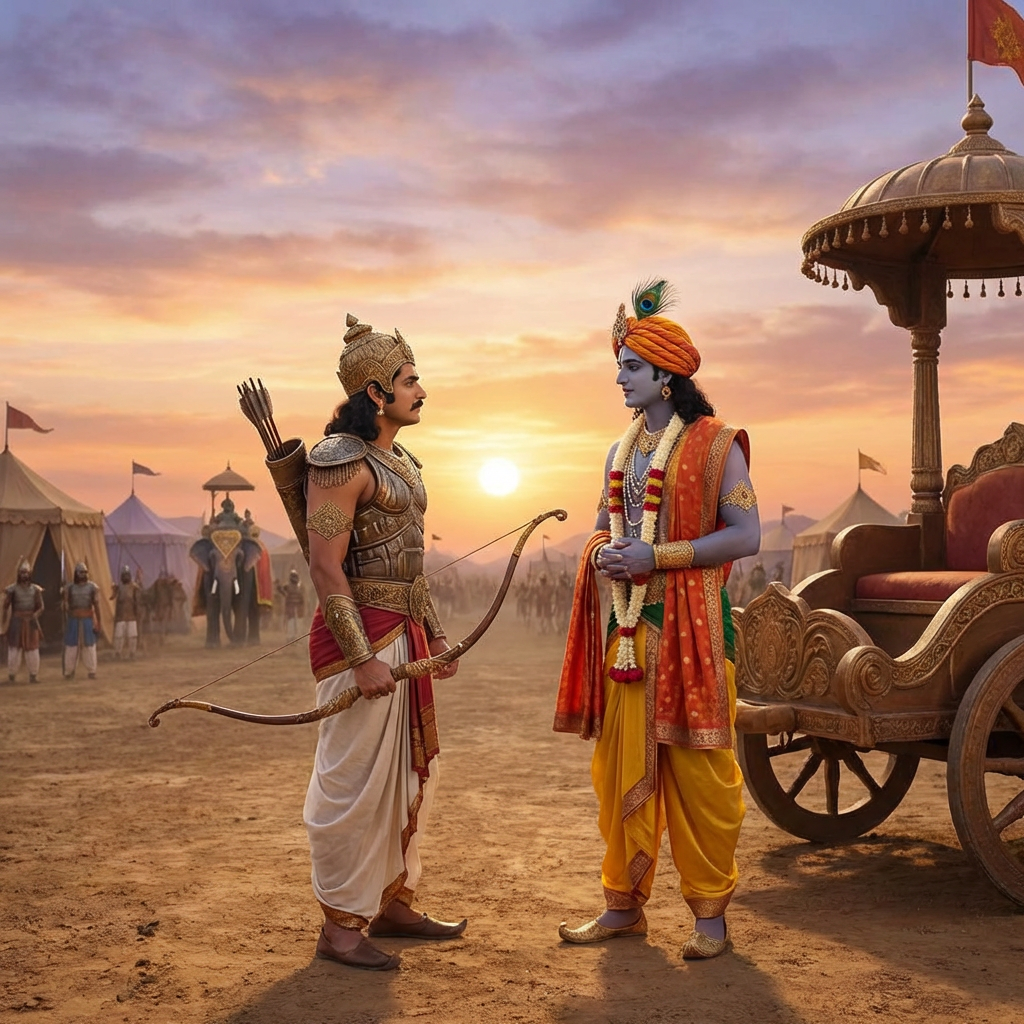
The Bhagavad Gita opens on the eve of a battle that will destroy families and reshape civilizations. Arjuna is the greatest warrior of his age. He has years of preparation behind him and a righteous cause in front of him. Yet, he collapses. His bow falls from his hands. He cannot go on. Not because he is weak. He sees the full cost of what he is about to do. His intelligence allows him to understand the real weight of it.
I have sat with founders in that exact moment. Different battlefield, same collapse. The paralysis is identical.
His charioteer — Krishna — does not immediately tell him what to do. He does not offer tactics. He asks questions. He holds a mirror. The dialogue that follows consists of 700 verses and eighteen chapters. It is the most concentrated body of wisdom about action under uncertainty ever written.
That is what Dharma is built on. Arjuna is not a metaphor for the founder. He is the founder.
Five Traditions, One Application
Dharma draws from five wisdom traditions. Each one speaks to a different dimension of what founders face.
The Bhagavad Gita — on duty and action without attachment
The Gita’s central teaching:
कर्मण्येवाधिकारस्ते मा फलेषु कदाचन। karmanye vadhikaraste, ma phalesu kadachana “You have the right to perform your actions, but not to the fruits of those actions.” — Bhagavad Gita, Chapter 2, Verse 47
Most people encounter this as a spiritual aphorism. Spend seventeen years with founders. You then recognize it as the most practically useful thing ever said about building a company.
The attachment to outcome is exactly what produces paralysis. Release the fruit. Act from duty. Act because the action is right, because the problem is real, because the customer needs what you are building. This is not passive resignation. It is radical engagement — full commitment to the action, full release of the result.

The Mahabharata — on moral complexity and the cost of right action
The Mahabharata’s most important teaching for founders is not a verse. It is a structural observation: dharma is not a rule. It is a living inquiry that is tested by fire.
Every major character is trying to do the right thing. Yudhishthira makes a catastrophic decision out of misguided honour. Karna knows what is right and cannot choose it because of prior loyalties. This is the tradition that speaks to the founder facing a genuine moral crossroads. It includes the co-founder conflict where both people are right. There is also the investor relationship where interests have diverged. Finally, it involves the hire they must let go. These situations do not resolve cleanly. The Mahabharata does not pretend they do.
The Buddha’s Teachings — on impermanence and the mind that suffers
The Buddha’s teaching on impermanence is invaluable. Anicca is the single most useful concept I know for a founder in a dark period.
The company that is struggling today is not permanently struggling. The founder who cannot believe in the vision at this moment is not permanently unable to believe. The market that is closed right now will not be permanently closed.
This is not optimism. It is observation. Things change. The practice is to act wisely while this particular state persists, without mistaking a temporary condition for a permanent truth.
The Thirukkural — on statecraft, people, and love
Thiruvalluvar wrote 1,330 couplets in Classical Tamil two thousand years ago. In the English-speaking startup world, he is almost completely unknown. This is a significant gap. His second book — Porul, on statecraft, governance, and reading people — provides practical insights. I have found it to be the most useful thing I’ve read about building organisations.
Consider Kural 442:
இடுக்கண் வருங்கால் நகுக அதனை அடுத்தூர்வது அஃதொப்பது இல். Itukkan Varungaal Nakuka Adhanai Atuththoorvadhu Aqdhoppa Thil “
If troubles come, laugh; there is nothing like that, to press upon and drive away sorrow.” — Thirukkural 621
That verse was surfaced by Dharma when I selected “Anxious” in the app this morning. Not a Gita verse. Not the Buddha. Thiruvalluvar — because his teaching on meeting trouble with lightness was the most contextually appropriate response to that particular state. The AI layer made that call. It was right.

The Way of the Awakened Builder — a new wisdom text, written for founders
The fifth tradition is different from the other four. It is not ancient. It was written this year. It is an original work in the tradition of aphoristic wisdom literature. It draws from Taoism, Zen Buddhism, the Gita, and the Buddha.
It is called The Way of the Awakened Builder — 108 Verses for Those Who Build.
Many of you will recognise the register immediately. George Lucas drew directly from Zen Buddhism and Taoism when he built the Jedi Order. “Fear is the path to the dark side. Fear leads to anger. Anger leads to hate. Hate leads to suffering” — that is the Buddha’s chain of dependent origination in twelve words. “Train yourself to let go of everything you fear to lose” — that is the Gita’s teaching on non-attachment.
The Way of the Awakened Builder goes back to those same sources. It writes something new from them. This is not Star Wars or a fictional universe. It is a text in the same sparse, direct, luminous register. It is written specifically for the person who builds things.
Seven chapters. 108 verses. This is how it closes:
The way of the awakened builder is not a destination. It is a direction. Every day you choose it again. Some days it chooses you. This is enough. Begin.
The Founder’s Crisis Compass
At the heart of Dharma is the Crisis Compass. It is a Socratic dialogue in the tradition of Krishna’s counsel to Arjuna. It starts not with answers, but with questions.
For founders, there is a dedicated mode: twelve archetypes drawn from seventeen years of direct observation of what founders actually face:
— My co-founder and I are no longer aligned
— I have run out of runway and must decide now
— I don’t believe in what I’m building anymore
— I hired someone who trusted me and must let them go
— I succeeded and I feel nothing
— Someone I trusted has betrayed the company
— My investors and I want different things
— I am exhausted and cannot see the path forward
— My best people are leaving
— I must make a decision with incomplete information
— I am succeeding by compromising my values
— I built this to change the world and it isn’t changing anything
Each one opens a dialogue. The app never tells you what to do. It holds a mirror. It asks the questions that help you find your own clarity. It closes every session with a single practical step — the smallest right next action — grounded in the teaching.
I tested the Exhaustion archetype while exploring the app today. The first question it asked was:
“How long have you been running at this pace? And whose voice is it that tells you this pace is required? Is it the market, your investors, your co-founder, or the voice inside you that equates rest with failure?”
That question goes somewhere most conversations do not. It is the question. The Buddha’s Middle Way, the one he discovered after nearly killing himself with austerity, is the teaching that follows.

Gurudakshina — the ancient giving principle
Dharma is completely free. No subscriptions, no paywalls, no locked features.
At certain moments, the app offers you the opportunity to give what you feel the teaching has been worth. This happens after a Crisis Compass session that resolves something. It also occurs after thirty days of daily practice. Additionally, it happens when a verse genuinely shifts something. Any amount. No suggested figure. No anchoring.
This is drawn from the Mahabharata’s story of Ekalavya. He was a student who taught himself archery from a clay statue of his guru. Ekalavya practiced in the forest, alone, until he surpassed every student in the royal school. When the teacher finally asked for his Gurudakshina, Ekalavya gave without hesitation. The teaching had been worth more than he could calculate.
The Buddhist tradition calls this Dana — generosity as a spiritual practice, given from devotion rather than obligation. Two traditions, a thousand miles and five centuries apart, arriving at the same principle independently.
The giving moment in Dharma is initiated by you, not the app. That is what makes it Gurudakshina, not a subscription.
Built for the founder who has no one to call at 11pm
I built Dharma for every founder I have not yet met.
The ones in Reykjavik, yes. Also, the ones in Bangalore, Lagos, Helsinki, São Paulo, and every other city. People in these places are building something real. They are running into the questions that have no tactical answer. Startup Iceland can reach the founders in its physical community. Dharma can reach the rest.
If you are building something right now, you might be in one of the twelve moments I described above. You might also be approaching one. I want you to have access to the best thinking humanity has produced about exactly what you are facing.
It is not in a business book. It is not in a TED talk. It has been waiting for two thousand years. It is found in languages most of us never learned. It is also found in texts most of us were never told to read.
Dharma makes them available. In three minutes a day. In the language you speak. In the tradition that finds you.
Open it at dharma.startupiceland.com The battlefield is not new. Neither is the wisdom. What is new is that it is now in your pocket, whenever you need it.
Bala Kamallakharan is the founder of Startup Iceland and managing director of Iceland Venture Studio. In 2025, he received the Order of the Falcon. The President of Iceland honored him for his work building Iceland’s startup ecosystem. He has been investing in, mentoring, and supporting founders across Iceland and beyond for seventeen years.
Discover more from Startup Iceland
Subscribe to get the latest posts sent to your email.
