
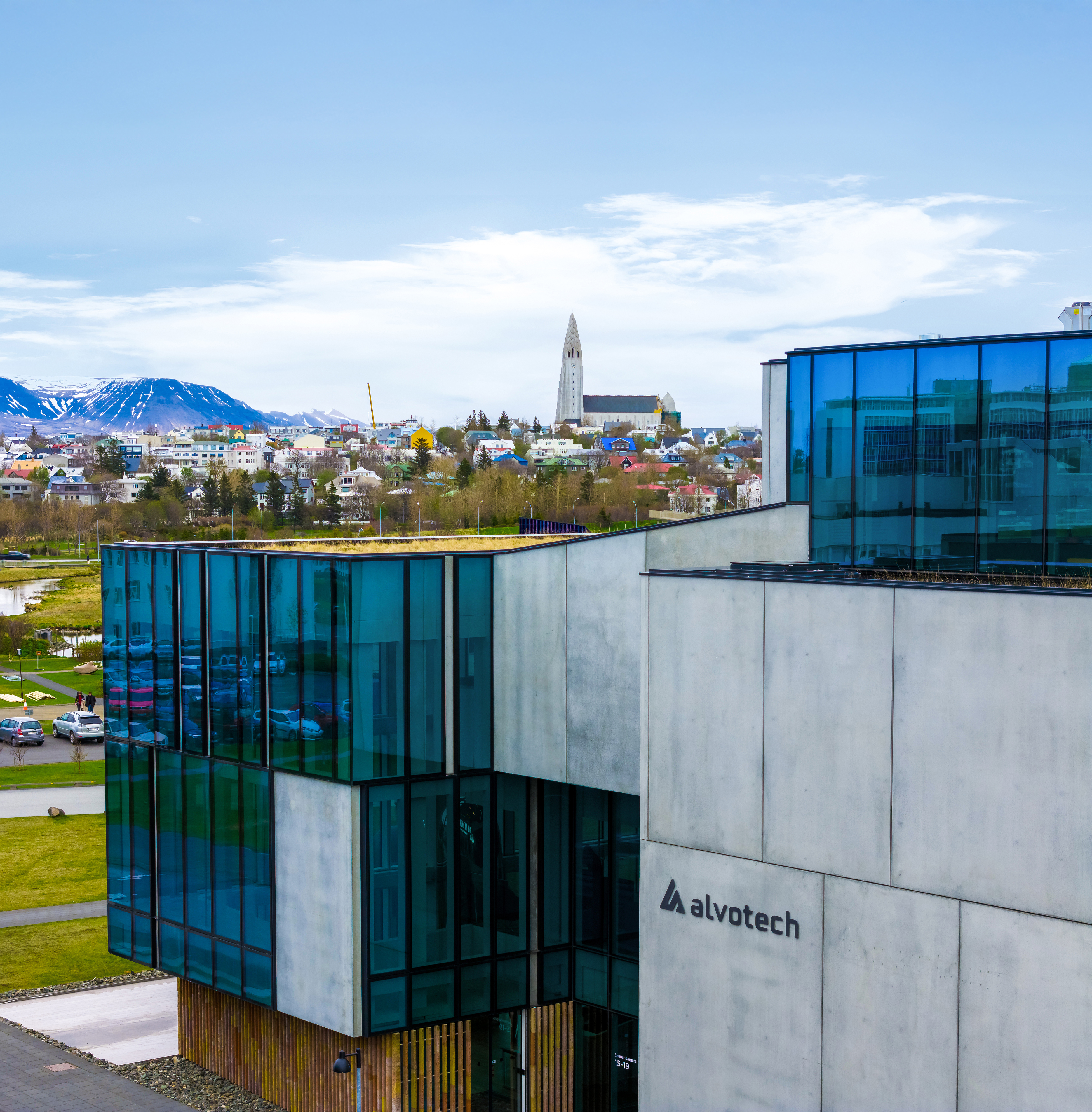
Alvotech reported its third quarter on 11 November, and over the next two trading days the shares fell from about $4.92 to about $4.19, roughly 15%. I own a small number of those shares. So I read the release, the nine-month accounts and the transcript of the call with more attention than usual, and with a suspicion of my own reading that I will come back to.
For most of the last two years the question about Alvotech was whether the factory in Reykjavík could satisfy the FDA and produce at volume. I have come to think this quarter answered that question and put a harder one in its place. The factory works. What nobody outside the company can see yet is whether it turns into cash before the balance sheet needs another cheque from outside, and the number everyone is watching, adjusted EBITDA, is not built to tell us.
A factory that finally works
Product and service revenue was $58.2 million, up 78% on the same quarter last year and 6% on the second quarter. Adjusted EBITDA was $31.5 million, against $14.4 million a year ago and 40% above the second quarter. Gross margin was 54%, three points better than the quarter before.
Behind those numbers are things an engineer would recognise as real. In October the FDA approved a second production suite in Reykjavík for the US market, and a new process that gets more than twice the output from each batch.
Now the other half. Total revenue was $111.6 million, well short of what analysts expected. For the nine months, revenue is $323.4 million against $420.0 million a year ago, and the company has lost $140.7 million after interest and tax, where it made $136.5 million in the same period of 2025.
Read those together. The direction is right and the level is low.
One quarter has to be worth three
Management kept its guidance for 2026: revenue of $650 to $700 million and adjusted EBITDA of $180 to $220 million. It now says the result will be toward the lower end of both.
Take the bottom of each range and subtract what has been delivered. The fourth quarter needs $326.6 million of revenue and $101.7 million of adjusted EBITDA. That is 2.9 times the revenue of the third quarter and 3.2 times its EBITDA. It is more revenue in three months than in the first nine.
The chief executive, Lisa Graver, says the fourth quarter will be the strongest in the company’s history, and I have no reason to think she is wrong. But on the call the chief financial officer, Linda Jónsdóttir, would not split the quarter between product sales and licence milestones, and three FDA decisions fall in December, on biosimilars to Prolia and Xgeva, to Simponi and to Eylea.
My reading, and it is mine and not the company’s, is that a meaningful part of the fourth quarter depends on approvals and agreements that land in the last weeks of the year. I would not bet on the number or against it. I note what kind of number it is.
Back to sixty million
Alvotech had $172.4 million of cash at the start of the year, $64 million at the end of March, $142.8 million at the end of June and $61.5 million at the end of September.
That fall understates what happened, because money came in along the way. In June the company sold new shares for $164.6 million, and over the nine months it took on $113.7 million of new borrowings. The cash flow statement for the nine months shows operations using $205.6 million and investment using $128.5 million. That is $334 million consumed in nine months. New money from shareholders and lenders covered about two thirds of it and the cash balance covered the rest.
The company’s own cash flow statement shows where it went. Before working capital and interest, operations produced $76.3 million in the nine months, against $73.0 million a year earlier. The business is generating a little more cash than it did. Then working capital took $172.9 million and interest took $109.1 million. A year ago the interest paid in the same nine months was $22.3 million, because much of the interest was then being added to the loans and is now paid in cash.


Management explains the working capital as stock built ahead of fourth-quarter deliveries. Anyone who has looked at a salmon farmer’s accounts knows that picture: the cash sits in the pen as biomass until harvest. I expected to find it in inventory and mostly did not. Inventory absorbed $27.9 million of the $172.9 million. Contract assets, which is revenue booked and not yet invoiced, took $46.6 million, other assets $37.7 million, paying down suppliers $35.4 million, and working off customer prepayments $27.3 million.
So less of the cash is in the pen than I assumed, and more of it is in revenue already counted. Of the $232.9 million of contract assets, $177.9 million is classed as non-current, which means the company does not expect to turn it into cash within a year.
Christopher Uhde of SEB asked the question directly on the call: are you fully financed to cash flow positivity? The answer was that the company expects to be cash flow positive in the fourth quarter, and that if it needs capital it is confident it can secure it. That is not a yes.
Time, bought at 12.5%
At 30 September borrowings were $1,396 million, up from $1,299 million at the start of the year, $1,069 million at the end of 2024 and $765 million at the end of 2022. Lease liabilities add another $165 million. Against that there is $61.5 million of cash, and $55.0 million of the borrowings fall due within twelve months. Shareholders’ equity is minus $267 million, even after the share sale in June. The company owes more than it owns.


Something was done about the balance sheet in the summer, and I went back to check what. In June Alvotech sold new shares for $164.6 million. On 1 July it announced a further $75 million term loan led by GoldenTree, at 12.5% with interest paid monthly in cash and due on 31 December 2027, alongside a $100 million facility agreed in December 2025.
Neither of these reduced the debt. In the nine months the company repaid $33.6 million of borrowings and took on $113.7 million. Net debt, which is borrowings less cash, went from $1,127 million to $1,335 million. The summer bought time, and it bought it at twelve and a half per cent.
I have a record of my own to hold this against. In the spring, when cash had fallen to $64 million, I shared a presentation of my analysis with Alvotech’s investor relations team and some of the people in finance. It argued that cash, not the income statement, was the gating variable until the fourth-quarter ramp arrived, and that the first job was to refinance the 12.5% tranche. Two quarters later the cash is at $61.5 million again, after $240 million of new money, and the 12.5% layer has been enlarged from $100 million to $175 million. I was wrong about what was achievable, because a lender does not usually refinance its most expensive loan for a borrower whose cash is falling. But I am reading the same sentence in November that I wrote in the spring.
Earnings before everything that costs cash
Everything in the guidance is stated in adjusted EBITDA, because that is the number the company steers by and the number the analysts model. Charlie Munger told Berkshire Hathaway’s shareholders in 2003 that every time they saw the word EBITDA they should substitute “bullshit earnings”. Warren Buffett made the same objection more politely in his letter for 2000, where he asked whether managements believe the tooth fairy pays for capital expenditures.
Their argument was simple. EBITDA is earnings before the costs a business like this cannot avoid: the factory that will one day have to be built again, the interest that is owed whether or not the quarter was good, and the cash that sits in stock and in invoices nobody has paid yet.
Hold Alvotech against that list. For the nine months, adjusted EBITDA is plus $78.3 million and cash after investment is minus $334 million. The two measures describe the same company over the same nine months and they are $412 million apart. Working capital, interest and the factory, the items in the cash flow statement above, account for most of it.


Alvotech spent $88.2 million on intangible assets in the nine months, against $24.6 million a year earlier, while the research and development expense in the income statement fell from $144.5 million to $63.6 million. I read that as development spending moving from the income statement, where EBITDA sees it, to the balance sheet, where it does not. The accounting rules allow this as products come close to approval. But adjusted EBITDA rose by $10 million over the year while the R&D expense fell by $81 million.
Put a year on it, and this part is my own construction. Interest paid is running at about $145 million a year. Investment, which is the factory plus the capitalised development, is running at about $170 million. Alvotech needs something like $315 million a year before a single dollar is left to repay the lenders, and the low end of this year’s guidance is $180 million of adjusted EBITDA.
I want to be fair to the number. EBITDA is a reasonable way to compare how two factories are run when they are financed differently, and a company that is ramping production should expect cash to lag behind it for a while. The working capital can come back. The interest, the factory and the development spending do not.
So I am not saying the EBITDA is wrong, and I think the improvement in it is real. I am saying it cannot answer the question that matters this winter. Alvotech could report $102 million of adjusted EBITDA in the fourth quarter, meet its guidance, and still need outside money. When management says cash flow turns positive in the fourth quarter, I take that to mean cash from operations, which in Alvotech’s accounts comes after interest and before investment, and that is the line I will read first.
A 2027 price on a 2026 balance sheet
There are about 357 million shares, so at $4.19 the market values the equity at about $1.5 billion. Add net debt of about $1.33 billion and the whole enterprise is priced at about $2.8 billion.
I am going to use EBITDA for this, having just argued against it, because it is the number the market prices and the lenders test. Keep the last section in mind while you read the multiples.
That is close to 16 times the low end of this year’s EBITDA guidance. It is a little over 9 times an EBITDA of $300 million. I draw one conclusion from those two numbers: the share price after the fall is not a price for 2026. It already assumes the company gets to something like $300 million in 2027.
Because the debt is so large against the equity, small changes in the business move the share price a long way. If I value the enterprise at 10 times EBITDA, which is my assumption and you should change it, then each $100 million of EBITDA is worth about $2.80 a share. At $200 million the shares are worth about $1.90. At $300 million, about $4.70. At $400 million, about $7.50. At 12 times, the same three cases give roughly $3.00, $6.30 and $9.70.
One more thing follows from the arithmetic. If new shares have to be sold at something like this price to get from here to there, every one of those per-share values comes down, because the same enterprise is divided among more shares.
The word I reached for was inventory
Charlie Munger’s habit was to turn the question round and ask how the investment fails. Here the list is short. The fourth quarter misses and cash falls below $61.5 million. One of the December decisions slips. A court in Virginia grants the injunction the maker of Simponi has asked for, and the launch that 2027 leans on moves to the right. Or none of that happens and the company still decides to raise equity while it can, at a price near today’s.
None of these needs the factory to fail. That is the change from a year ago, and it is a change for the better.
The second Munger question is the uncomfortable one. I own the shares. I live in Reykjavík, I have spent seventeen years arguing that global companies can be built from here, and I want this one to work. A person in that position reads a 78% rise in product revenue and feels vindicated, then reads an $81 million fall in cash and looks for the explanation that makes it harmless. I caught myself doing it with the word inventory.
The analysts on the call mostly asked about 2027: the Simponi launch, the Eylea patents, pricing for the Entyvio biosimilar. It is a comfortable place to stand, and I think the 2027 case is intact. But you are only allowed to look through 2026 if the company gets through 2026 without handing a slice of 2027 to whoever writes the next cheque.
Three lines to read on 10 March
Alvotech reports the fourth quarter on 10 March 2027. I will not start with revenue or with adjusted EBITDA when I open that release. Whether the year lands at $650 million or $640 million matters less than three other lines.
The first is cash at 31 December. If it is above $61.5 million and no new shares or loans explain it, the working capital was what management said it was. The second is cash from operations for the quarter, which management has said will be positive. The third is contract assets and receivables, because revenue that is booked and not yet collected is the same question moved one line down the balance sheet.
I am holding my shares and I am not adding to them. If the fourth quarter shows the working capital turning into cash, I would expect the market to stop pricing a financing and start arguing about 2027, and I will be glad to have been too cautious. If cash falls again, the price of the next raise will be set by people who know the company needs it.
For founders there is something here that has nothing to do with biosimilars. Alvotech has put more than $500 million into a factory in Reykjavík, the factory now does what it was built to do, and the share price fell 15% on the news. Building the thing and financing the gap between building it and being paid for it are separate jobs, and the second one decides who owns the company at the end.
Sources and disclosure
- Alvotech third-quarter and nine-month 2026 results, press release of 11 November 2026
- Alvotech third-quarter 2026 earnings call transcript, 12 November 2026
- Alvotech nine-month 2026 financial statement tables, from the company’s investor site, for the balance sheet and the cash flow statement
- Alvotech annual reports on Form 20-F for 2022 to 2025, for borrowings at each year end
- Share prices and share count from public market data as of 13 November 2026
- The fourth-quarter requirement, the annual cash need and the per-share values are my own arithmetic from those figures
I own a small number of Alvotech shares. Earlier this year I shared a presentation of my analysis with Alvotech’s investor relations team and members of its finance team, and I received no information from the company that is not public. Founders Ventures or Blue Nova Ventures do not own any shares in Alvotech. I have not bought or sold since the results. This is my reading of public documents and it is not investment advice.
Discover more from Startup Iceland
Subscribe to get the latest posts sent to your email.
